Showing posts with label Group Writing Exercises. Show all posts

Monday, February 13, 2017

"If I" Poem


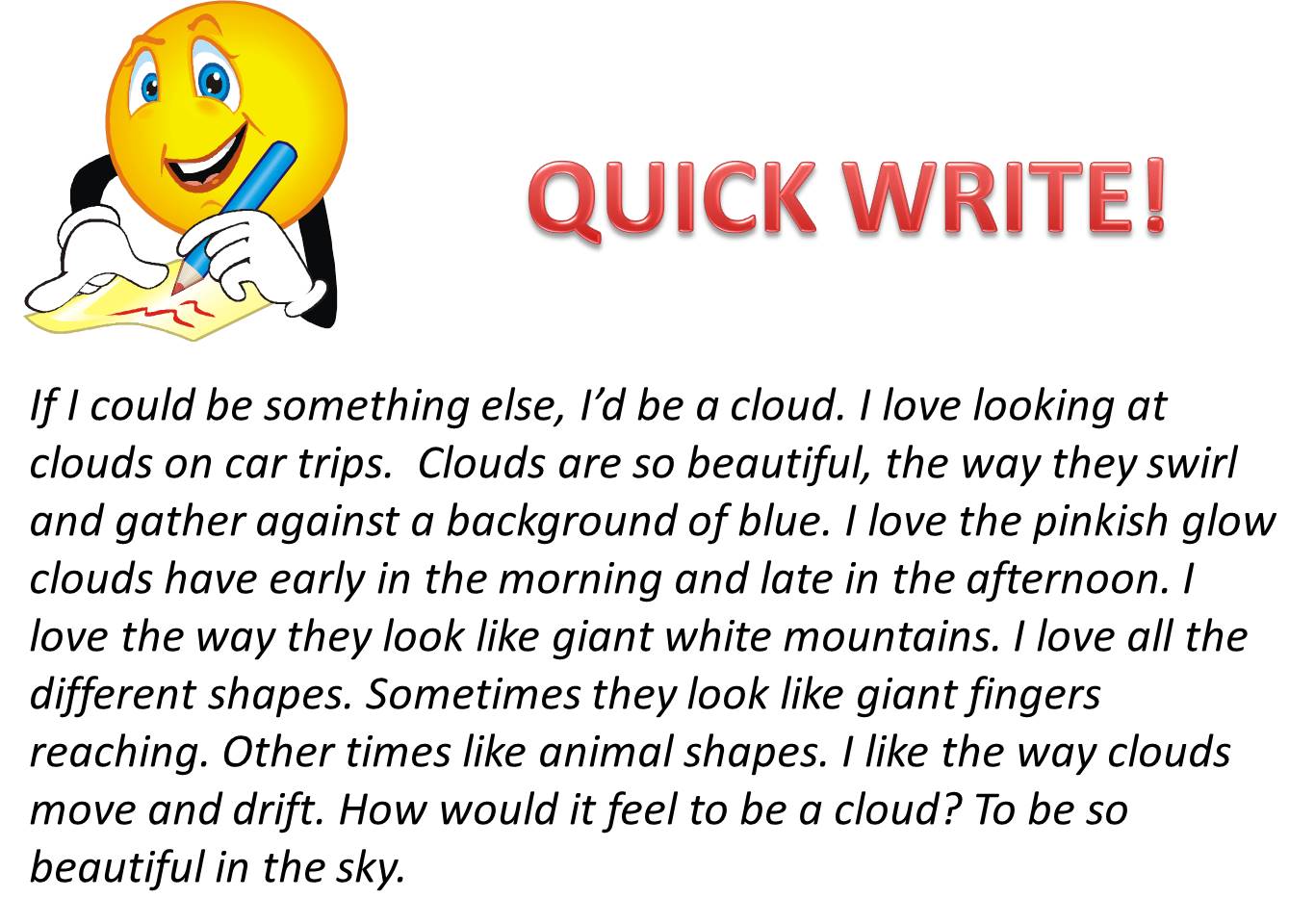
Writers of all ages are inspired by the simple suggestion to imagine themselves as a different entity. Model the process by using your own poem or my poem, “If I Were A Cloud.” I chose this subject because watching clouds is not only a joy but a consolation for me. Their floating beauty in the sky often lifts my spirits. To begin the exercise, ask your students to do a quick write on their chosen topic. Here is my quick write:


Then form a list of words that could be used in the poem to describe your feelings:


Finally, create the poem, using the line “If I were . . .” at the beginning of each stanza. Note that the poem does not have to rhyme. Encourage your students to choose figurative language over a forced rhyme scheme. It is more important to paint a picture for your reader than to rhyme. Here is an image of my poem, “If I Were a Cloud.”


In addition, or before you have students write individual poems, you might do a group writing exercise with the same process. Quick Write, Quick List of Words, Poem.

Have fun imagining!


Monday, April 25, 2016

I'M NOT--Writing About Fears with Peep and Egg


In Peep and Egg: I’m Not Hatching, Egg is scared of everything—from the too-high roof of the hen house to the too-dark sky at night.  Egg wants to stay inside of her nice, cozy, SAFE shell. 


When I present Peep and Egg to school groups, I ask kids to think about their own fears.  What would make them want to stay inside their eggs? 

When Egg finally hatches, it is because she wants to be with Peep, and because she wants to read a story.  I ask students, “What would make you hatch out of your egg?  What do you love enough that you would come out of your safe, cozy egg for it?” 

In your classroom, you may want to have each student make a chart—one half of the paper for What Would Make Me Stay in My Egg and one half of the paper for What Would Make Me Hatch.  Ask students to write a list, or draw pictures, on each side. 

(So far, I’ve found sharks to be the most popular answer for What Would Make Me Stay in My Egg and ice cream to be the most popular answer for What Would Make Me Hatch.)


Peep and Egg: I’m Not Hatching is the first in a series of books that will include Peep and Egg: I’m Not Trick or Treating, Peep and Egg: I’m Not Taking a Bath, and Peep and Egg: I’m Not Eating That.

Ask your students to think about an I’m Not title that reflects their own fears.  Ask, “What would YOU be scared to do?”  I often tell school groups that my title would be I’m Not Skydiving.

Next, ask students to write or tell an I’m Not story, with the story primarily written in dialogue like Peep and Egg. A student could use the characters Peep and Egg, she could use herself and a parent (“I’m Not Trying Out for the School Play!”) or she might use a scared penguin and a comforting polar bear (“I’m Not Ice Skating!”).  Anything goes! 

Writing I’m Not stories can help students think about their own fears in a humorous way.  I’m Not stories can also help kids remember that we can overcome our fears, although we may need a special someone like Peep to help us break out of our shells!


Laura Gehl is NOT skydiving!  But she IS the author of One Big Pair Of Underwear, a Charlotte Zolotow Highly Commended Title, International Literacy Association Honor Book, and Booklist Books for Youth Editors’ Choice for 2014; Hare And Tortoise Race Across Israel and And Then Another Sheep Turned Up (both PJ library selections for 2015 and 2016); and Peep And Egg: I’m Not Hatching, an Amazon Best Book of the Month for February 2016. A former science and reading teacher, Laura also writes about science for children and adults.  She lives in Chevy Chase, Maryland with her husband and four children.  Visit Laura online at www.lauragehl.com

Monday, March 26, 2012

Author and Illustrator for the Day, Part Two


In a previous blog post (January 2, 2012), I wrote about an upcoming “artist in residence” program I would be participating in at an elementary school. I'm happy to say I’ve just completed that residency with approximately 120 fourth graders.  It was wonderful getting a chance to know so many students by name, and by all accounts they really enjoyed creating their own books.  Prior to my arrival, I outlined a program and submitted it to the fourth grade teachers so they had a clear idea of what we would be doing.  The days broke down as follows:

Day 1: Introduction to the Art of Picture Book Illustration

What does an illustrator do?
How does an illustrator work?
How are illustrations for a book created?
How does the illustrator work with an author…or do they?

*manuscript acquisition
*thumbnail sketches
*final sketches and dummy book
*final art
*description of the printing and binding process
*printed book
*Q&A

Hands on:
-Explanation of the project student groups will create in the four days of workshops.
-Groups formed and “story prompt” cards will be created by students.
-Story cards mixed and randomly redistributed to groups.
-Students begin to brainstorm story ideas.

Day 2: The Writing Process

What makes a good story?
What elements should be included in a story?

*Memorable characters
*Beginning, middle, end
*Story Arc
*“Show,” don’t “tell”
*Pacing and page turns
*Writing to allow for interesting illustrations
*Satisfying endings
*Revisions

Hands on:
-Groups work on stories based on the story prompt cards they received.
-Text divided to fit on eight pages

Day 3: The Illustration Process

*different styles used in illustration
*different mediums used in illustration
*different color palates used in illustration
*giving the reader more than just depicting the written word

Hands on:
-distribution of thumbnail sketch sheets
-distribution of blank books (created using heavy weight construction paper folded and stapled )
-final sketches worked on if time permits or will be worked on at home that night. (Each student will be illustrating their own version of another group’s story).

Day 4: Presentation of Eight Page Books

Hands on:
*Students will be given a little time to complete illustrations for their stories and ask questions.
*One student from each group will read the story to the class and other students will present the art they created for the story.

Some questions to ask:

Are the illustrations successful for this manuscript?
Do they add something new and exciting to the story?
Do the characters come to life in the illustrations?
Do we get a good sense of place and time when looking at the illustrations?
Is the author (group) happy with the way their story has been illustrated? Is there a way the story could be edited to allow for more exciting illustration opportunities?
Was it fun to illustrate another group’s story?

For the most part we stuck to this schedule, but after the first day the teachers and I made one change.  The students were so excited about the stories they were working on and were already doing sketches of characters. I was told it was all they talked about for the rest of the day! Since they were already so invested in their work, we decided to forgo the idea of reassigning the stories to different groups to illustrate. I think this idea would work better if this was explained at the beginning of the project, or if the exercise was used in an older age group.

Next week all 120 books will be on display at the school so the entire student body can view the finished books. I was so proud of the work the children did, and so were they. If you think a book featuring a Nike sneaker, the zoo, and getting lost would be difficult to write, you just have to read Detective Nike and the Missing Panda!

Monday, March 12, 2012

PENCIL TIPS: THE WRITING GARDEN


As the weather warms and eyes turn from page or screen to the greening world, a field trip can help enhance students’ writing skills and pleasure.

And you need not travel far.  Many schools today have created small gardens or grounds that can be used as outdoor classrooms.  Alive with plants, pollinators, and regional wildlife, these green spots offer hands-on and real-life lessons in math, science, natural history, geography, literature, and the arts.  You can also take a beyond-school writing trip to a public garden.

1.  In the classroom, prepare students by sharing poems or descriptions of plants, insects, and birds.  What details make the writing vivid?  Did the writer like or dislike this thing?  (See below for some of my favorite poems/descriptions.) 

2.  As a class, have them list things they think they will find in the garden.

3.  Have them bring their writer’s journals and pencils outdoors and challenge them to (1) look for the things they thought they would find, (2) add details (such as color, name, smell, texture, sound, and so on to “flower,” “butterfly,” or “bird,” for example), and (3) write down things/details they hadn’t expected.

4.  In the classroom, discuss their findings.  What were some surprises?  What one natural thing did they find most interesting?  Why?

5.  Ask them to write a short description or poem that includes specific details and three of the five senses.  For younger kids, you might also have them draw/color a picture and post their writings/drawings in the classroom for an “indoor garden.”

For more information on creating or teaching with a school garden, check online resources offered by the National Wildlife Federation www.nwf.org/schoolyard and National Gardening Association www.kidsgardening.org.

Some favorite garden poems/descriptions:

“Orchids,” “Weed Puller,” “Old Florist,” and “Moss-Gathering,” by Theodore Roethke in The Collected Poems of Theodore Roethke.

“Petaling” and “Me Boy. You Plant.” by Heidi Mordhorst in Pumpkin Butterfly.

 “You Never Hear the Garden Grow,” “The Nest,” “Cricket” in The 20th Century Children’s Poetry Treasury, edited by Jack Prelutsky.


Monday, January 30, 2012

DIALOGUES AND TWO PERSON POEMS

by Mary Quattlebaum

Have you ever read dialogue that feels rambling and flat?  (Ha, sometimes I’ve written such dialogue and then, of course, had to revise.)  To help students think more carefully about the point of and voices in a piece of dialogue, try this:

*Have students make up one big and one very small character (for example, seagull and tiny crab, child and ant, cat and mouse).  One wants something that the other has (for example, the gull might want to eat the crab; or the ant might want child’s cupcake crumb).  What do they say to one another?  How are their voices different?  (For example, the gull might be rude and the crab very polite.  Or the ant, though tiny, might be very bossy and the child apologetic.)  What happens and how does the dialogue end? 

*Once students have written and revised their dialogues or two-speaker poems, have them pair up with someone in class and speak/perform the part of their two characters.  Have fun!

Below is an example of a two-speaker or dialogue poem. In “Encounter,” a girl and firefly have an imaginary conversation about their different experiences of firefly being caught by girl and then released.

                                Encounter

     Girl                                       Firefly
                                                                                                   
Quick leap,
turned wrist.
Bright dot
in my fist.

                                                  Night wide—
                                                  sharp snap!
                                                  I flicker
                                                  in a trap.

Gliding spark,
quiet flash:
go forth,
go fast.

                                                  Sudden window
                                                  opens high;
                                                  warm wind
                                                  whispers “fly.”

                    --by Mary Quattlebaum, Cricket magazine

Monday, September 19, 2011

CRAFTING STORIES TOGETHER

by Pamela Ehrenberg


We're all social creatures—even, or maybe especially, writers.  I remember this each time I see the other Pencil Tips bloggers and a few dozen other "book people" at meetings of the
Children's Book Guild of Washington, DC.  The social hour at the beginning of each meeting looks something like a bee hive: dozens of authors, illustrators, and librarians, otherwise content to putter away on their own, are suddenly set free in a room buzzing with social energy, and we need to absorb enough to last through the coming weeks of solitary creation.

For young writers, various types of group story exercises can channel some of that social buzz, directing it in a way that's productive for writing and helping writers build enough trust to feel comfortable giving and receiving feedback.  Writopia workshops, with three to six participants each, use this form of the group story exercise to create fiction stories:

First, participants brainstorm several possible settings and several possible problems for the story, selecting one of each. Together, they flesh out the characters, making sure to choose the same number of characters as there are workshop participants.  They think through what each character looks like, what each character wants, and what the characters are likely to do to try to get what they want.  The students determine an outline of the plot, along with beginning and ending lines for each section—then each person writes a section of the story, from one character's point of view.

Hilarity often ensues.  Surprisingly strong writing often ensues too.  But most importantly, kids who didn't even know each other an hour earlier have now shared the intimate process of crafting a story—giving them courage to support each other as they move forward with their own work.

It can be a challenge for us as teachers, and writers, to break down our ideas of writing as a universally solitary activity.  But exercises like group story can help students get their first tastes of what it's like to be part of a writing community.  Now there's something worth buzzing about.

http://www.pamelaehrenberg.com/

P.S. Don't forget to comment for a chance to win a copy of Pam Smallcomb's I'm Not!


PENCIL TIPS GIVEAWAY!
Win a signed copy of I'm Not by Pam Smallcomb
To enter, leave a comment on a Pencil Tips blog post
Random winner contacted September 30th

"...a fresh take on friendship/reassurance stories and is, for sure, not boring"
- starred review Kirkus Reviews December 2010

Leave a comment at any Pencil Tips blog post between now and September 30th
for a chance to win a signed copy.