Showing posts with label Schneider Family Awards. Show all posts

Monday, January 1, 2018

Fish in a Tree


Fish in a Tree by Linda Mullaly Hunt (Puffin, 2015) features several middle schoolers who don’t fit in – as well as a pair of girls who tease all the others mercilessly. Ally is at the center of it all, spending as much time in the office as in class because she makes inappropriate comments or no comments at all and often creates a problem to avoid doing work she finds difficult.  She talks about the mind movies in her brain: “My mind does this all the time – shows me these movies that seem so real that they carry me away inside of them. They are a relief from my real life.”


Ally’s real life includes frequent headaches and “letters that dance and move on the page.”  When a new teacher gave her a journal to write in every day, she thought she’d rather eat grass. She draws instead. An observant teacher finally realizes Ally has dyslexia and slowly life begins to be worth living.  

Fish in a Tree provides many openings for thought-provoking discussions and writing (or drawing) that could help students become more sensitive to each other’s problems – or aware of their own.  For example, ask students if they can read the words in this phrase:
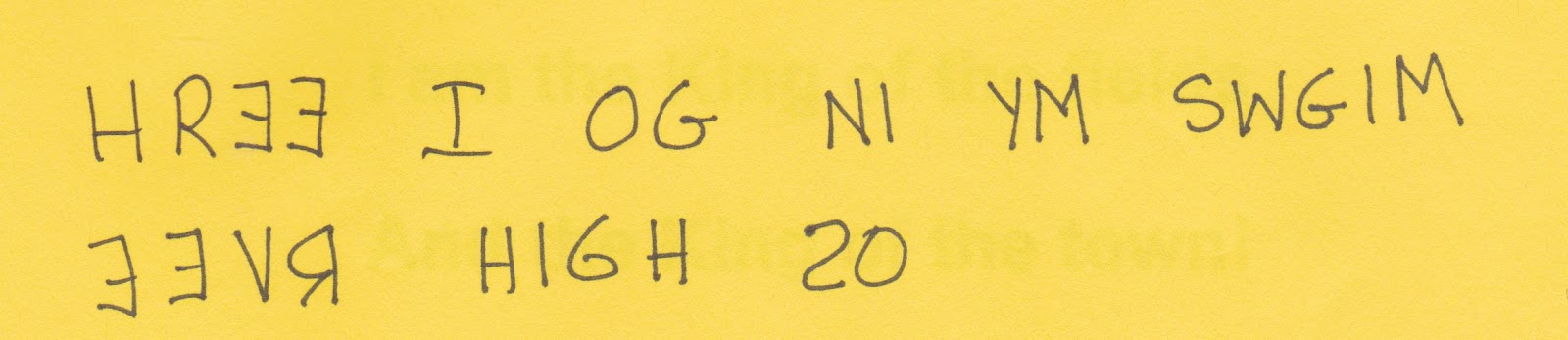


The phrase says, “Here I go in my swing” but it looks like the jumble above to a child with dyslexia.

The teacher, Mr. Daniels, had commented that, “If you judge a fish on its ability to climb a tree, it will spend its whole life thinking that it’s stupid.” After reading the book, ask students to figure out what the teacher means and how it applies to Ally – or perhaps themselves.

Ally suffered for a long time without letting anyone know she had problems reading.
·       Why is it so hard to ask for help when we need it?
·       Why do certain kids always tease and make life difficult for those who are different?

Ask each student to write a paragraph or a poem or draw a picture about some task or activity that is difficult or challenging for them. 
·       If this is an activity you have to do – like reading or math – how do you solve the challenge? Who helps you, if anyone?  What kind of help would you like?

In this picture, a young boy shows that he is not as skilled as his friend on the skateboard but he certainly showed what a wonderful artist he is! Everybody is smart in different ways.


Fish in a Tree won the Schneider Family Book Award  in 2016 as a book that embodies an artistic expression of the disability experience for child and adolescent audiences.
  

Monday, January 18, 2016

“Freedom never comes on a silver platter”


“Ghana reminds us that freedom never comes on a silver platter. It’s never easy…It comes through hard labor and it comes through toil.”


Dr. Martin Luther King, Jr. spoke about Ghana after attending independence celebrations in this West African nation in 1957, at the invitation of Ghana’s new Prime Minister Kwame Nkuramah 

Twenty years later, Emmanuel Ofosu Yeboah was born in Ghana.

“Two healthy lungs let out a powerful cry,
two tiny fists opened and closed,
but only one strong leg kicked.”


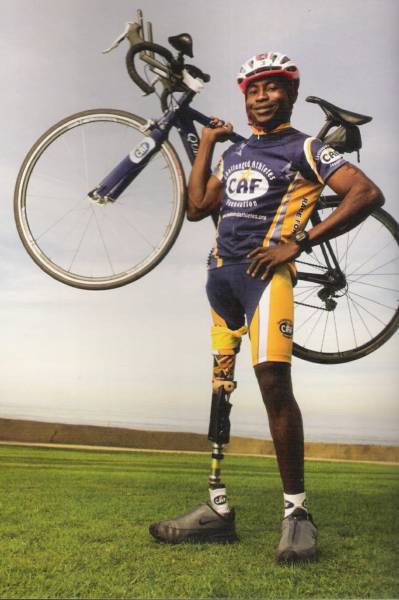
Laurie Ann Thompson wrote and Sean Qualls drew Emmanuel’s Dream: The True Story of Emmanuel Ofosu Yeboah.  We often hear about Dr. King’s dream. But Emmanuel had a dream too.  Emmanuel hopped to school on his one leg; he played soccer “lunging and spinning on crutches.” He learned to ride a bicycle and when he was only 13, he snuck away to the big city of Accra to earn money to send home.

Emmanuel’s mother died when he was still a boy, but she told him, “Be respectful, take care of your family, don’t ever beg. And don’t give up.”

Those words were a gift. Emmanuel would show everyone that “being disabled does not mean being unable.”

Freedom never comes on a silver platter.


Emmanuel rode his bike all over Ghana. He wanted everyone to see him - and his disability. “People with disabilities left their homes and came outside, some for the very first time….He proved that one leg is enough to do great things - and one person is enough to change the world.”  Now he has a foundation called Emmanuel’s Dream  that is changing society by empowering people with disabilities.

Emmanuel’s story can inspire student writing (or drawing) at many grade levels.

        What is your dream? What can you do to help make your dream come true?

At first nobody played with Emmanuel, but he earned their respect by learning to kick a soccer ball with his good left foot and learning to balance on his bicycle with the help of a friend.

        What could you do to help someone who seems left out at lunch or on the playground?

Emmanuel’s Dream is a brand new winner of the 2016 Schneider Family Award for books that embody an artistic expression of the disability experience. It is also recommended for Read Africa Week February 1 to 7: the first week of Black History Month. Africa Access and Howard University invite teachers, librarians, parents and other concerned adults to introduce young people to great books about Africa all the time, but especially during Read Africa Week.  It is a perfect way to honor Martin Luther King, Jr. and introduce children to new people and countries to admire.


Monday, March 30, 2015

Differently Abled Writers

by  Karen Leggett Abouraya

Each year, on the same day we learn about the life-changing Newbery and Caldecott Awards in children’s literature, the Schneider Family Awards are announced, honoring authors for their portrayal of the disability experience.  This year’s winners are:


·  Alan Rabinowitz and illustrator Catia Chien for A Boy and a Jaguar (for children up to age 8) – about his own life as a boy who stuttered except when he talked to animals,
·  Rain Reign by Ann M. Martin (ages 9 to 13) – about a girl with autism who must leave the security of her routines to find her beloved dog after a storm, 
·  Girls Like Us by Gail Giles (teens), about two girls with learning and developmental disabilities who are making the difficult transition to independent living after high school.

All three books enable young readers to see life from the perspective of someone who thinks and works differently, but is not really that different in the ways that matter most. And as it turns out, one of the Newbery Honor books this year is by Cece Bell (El Deafo), an author who is deaf and made a marvelous video about her experiences. There are most likely some differently abled youngsters in your classes.

Nic Stearns, a founder of the ArtStream inclusive theatre in Maryland/Virginia, is about to publish a children’s story written jointly with Megan, a young woman who has Down’s Syndrome. 

As we come to the very end of National Developmental Disability Awareness Month, I’d like to share the type of conversation Nic has with Megan that helps build the story and can serve as a model you can use in class to help every student feel like a writer. The role of Nic in the conversation can be played by a teacher, an aide or even another student (perhaps an older student mentor).  Nic and Megan are writing a story about two friends, Pauline and Tiff.


Nic: "What is Pauline's favorite color?"

Megan pointed at her own purple shirt.

"Purple? Does she wear a lot of purple?" Nicolette asked.

Megan answered, "Yes. Only purple."

Nicolette asked, "What does Pauline like to do? Does she like to sing or does she like to dance?"

"Tap dance!" Megan answered excitedly.

"Does Pauline wear her tap shoes at home?" Nicolette asked.

"Yes," answered Megan.

Nicolette asked, "Well, how about at school?"

"Yes," Megan said.

"Where else does she wear them?" Nicolette wondered, "To the grocery store?"

"Yes," Megan affirmed. "And when she gets ice cream."

Often, Nic moved the story along by giving Megan fill-in-the-blank sentences: “The most important thing about friendship is………..”

As Nic Stearns says, writing became an “opportunity to look beyond Megan’s disabilities to see the beautiful, creative person she is.” (More about ArtStream and the writing project here.)

http://childrensbookguild.org/karen-leggett-abouraya