Showing posts with label Writing Models. Show all posts

Monday, May 20, 2019

Except When They Don't


Except When They Don’t is written by Laura Gehl and illustrated by Joshua Heinsz. The book is about how girls always love pink and princesses, and boys always love blue and robots…except when they don’t! In other words, it is a book that encourages kids not to worry about gender stereotypes and to just be themselves.


After reading Except When They Don’t out loud, try these writing activities with your students:

1. Make a list of “boy” stereotypes and “girl” stereotypes. Then write a story with a main character who does not fit with these gender stereotypes. Maybe you will write a story about a girl who is a football star, or a boy who has the lead role in a ballet. Maybe you will write about a boy who loves wearing necklaces to school, or a girl whose favorite toys are cars.  Remember: your character should have lots of sides to his or her personality, just like every real person does! A girl who loves football might also love pink and be great at math and have five pet cats. A boy who loves wearing necklaces might also be the president of the school student government and play soccer at recess and play the drums in the school band.

2. Can you think of a time in your own life when you felt like you couldn’t do something because of your gender? Maybe you couldn’t get the sparkly red shoes at the shoe store because they were “girl shoes.” Or maybe you couldn’t sign up for wrestling because “that’s for boys.”  Or if you can’t think of a memory like that, imagine that you have a friend coming to you with a secret. Your friend wants to paint his nails, but he is embarrassed to ask his mom to borrow her nail polish, because nail polish is just for girls. Or maybe your friend wants to cut her hair really short, but she is worried everyone will say she has a “boy” haircut. What advice would you give your friend? How could you help?

3. Imagine that you are the owner of a toy store. There are dolls, tea sets, trucks, trains, markers, robots…every toy you can imagine. What if a customer came up to you and said, “I want to buy presents for a little girl and a little boy. Can you give me some advice?” What questions would you ask the customer? How would you decide which toys to recommend?

4. Starting in elementary school, sports teams are usually separated by gender. There are girls soccer teams and boys soccer teams, girls basketball teams and boys basketball teams. Do you think this is a good idea or a bad idea? Why?

5. Imagine 100 kids (50 boys, 50 girls) growing up with human parents and 100 kids (50 boys, 50 girls) growing up with alien parents. The alien parents just arrived on earth and don’t know about our human gender stereotypes. Do you think the kids raised by aliens would grow up wearing different types of clothes and liking different activities than the kids raised by human parents? Why or why not?

 Laura Gehl is the author of picture books including One Big Pair of Underwear (Charlotte Zolotow Highly Commended Title, International Literacy Association Honor Book, Booklist Books for Youth Editors’ Choice); Hare and Tortoise Race Across Israel, And Then Another Sheep Turned Up, and Koala Challah (all PJ Library selections); the Peep and Egg series (Parents’ Choice Recommendation, Amazon Editors’ Pick, Children’s Choice Book Award Finalist); My Pillow Keeps Moving (Junior Library Guild selection, NYPL Best Books of 2018 selection); and I Got a Chicken for my Birthday (Kirkus Best Picture Books of 2018 selection). 2019 releases include Except When They Don’t (Little Bee), Dibs! (Lerner), Juniper Kai: Super Spy (Two Lions); Judge Juliette (Sterling); Always Looking Up: A Story of Astronomer Nancy Grace Roman (Whitman); and the Baby Scientist series (HarperCollins). Laura lives in Chevy Chase, Maryland, with her husband and four children.  Visit her online at www.lauragehl.com


Monday, February 13, 2017

"If I" Poem


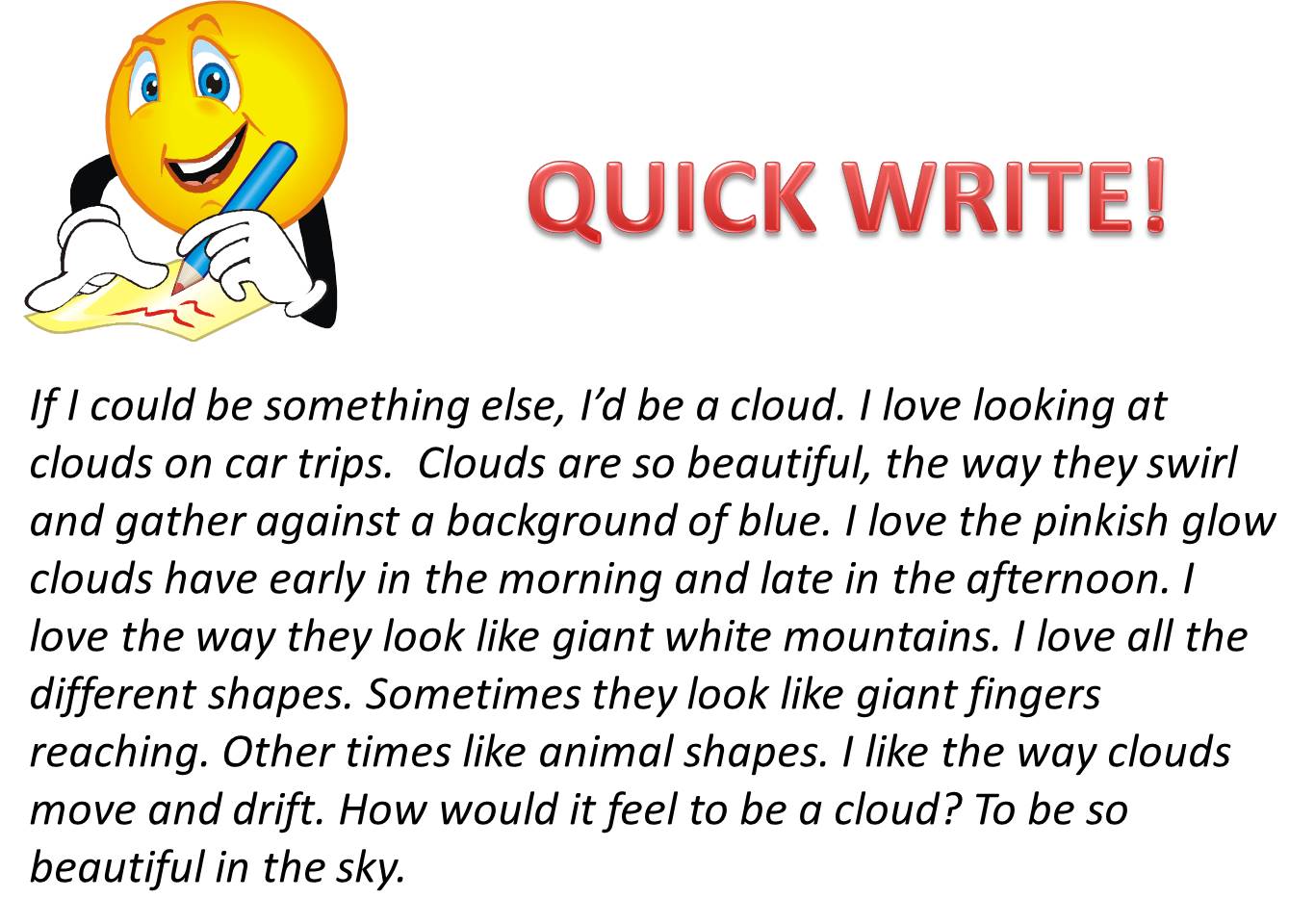
Writers of all ages are inspired by the simple suggestion to imagine themselves as a different entity. Model the process by using your own poem or my poem, “If I Were A Cloud.” I chose this subject because watching clouds is not only a joy but a consolation for me. Their floating beauty in the sky often lifts my spirits. To begin the exercise, ask your students to do a quick write on their chosen topic. Here is my quick write:


Then form a list of words that could be used in the poem to describe your feelings:


Finally, create the poem, using the line “If I were . . .” at the beginning of each stanza. Note that the poem does not have to rhyme. Encourage your students to choose figurative language over a forced rhyme scheme. It is more important to paint a picture for your reader than to rhyme. Here is an image of my poem, “If I Were a Cloud.”


In addition, or before you have students write individual poems, you might do a group writing exercise with the same process. Quick Write, Quick List of Words, Poem.

Have fun imagining!


Monday, October 10, 2016

The Essence of Everyday Life


I have recommended Gary Soto before in a Pencil Tips post about his short story collection, Baseball in April. But when I recently came upon his collection of poems for young adults, A Fire in My Hands, I knew I had to write about Soto’s work again. A Fire in My Hands was re-issued in an expanded edition.  All middle school and high school English teachers need a copy of this book.


Soto is one of my favorite authors.  His words beautifully capture the essence of everyday life. Every poem in A Fire in My Hands is a wonderful example of how to create poetry from one’s life experiences. Soto shows us how to notice every detail of a visit to a drugstore with someone you care about. How to see a blimp float across the sky on a hot August day, “quietly as a cloud, /Its shadow dark enough to sleep/ Or dream in.” Soto elevates the everyday to palpable moments of epiphany.

In the introduction, Soto advises young writers to look into their own experiences for inspiration. This is not new advice for middle school and high school students. But Soto knows how to convince them. He says, “Some of you may argue that your life is boring, that nothing has happened, that everything interesting happens far away. Not so.” Soto’s poems demonstrate that every moment is worthy of being captured in a poem. Every feeling is important.

Each poem is accompanied by an anecdote, sharing the memory that inspired it. Soto is honest about changing the facts to capture emotional truth in his poems. This layout is a wonderful model, showing how a poem develops from its original inspiration.  

The interview at the end of the book “Chatting with Gary Soto” is a must-read for anyone interested in teaching poetry. Soto discusses his process and motivation. He explains the difference between a lyric poem and a narrative poem. But most of all, he reveals how writing poetry feeds his soul.

A Fire in My Hands models everything we want our students to emulate in their writing. Get it for yourself. Share it with your students.


Monday, December 28, 2015

HOW TO BEHAVE AT SCHOOL

Guest Post by Madelyn Rosenberg

When I wrote my how-to-behave books, I wanted to invoke the idea of a vintage manners book, the kind whose cover stars included a young lady in pin-curls and a young gentleman nearly choked by his skinny, black tie. And, because those books are ridiculously hard to adhere to – So many pages! So many rules! -- I wanted everything to blow up. To make that happen, prim and proper Julia needed a foil (or two or four). And she needed to learn that when it came to fun, other people’s rules were important, too.


The books work to stimulate a discussion with students as you work together to set classroom rules and expectations in September -- or as you revisit those rules at the start of the new year.  They also lead into a fun exercise of do’s and don’ts for starting a school day on the right foot.


Here are some examples from my books:
From How to Behave at a Tea Party: We DO send out invitations, sip quietly, and hold our tea cups just so.
We DO NOT burp like Uncle Victor or make towers out of the tea cups. We do not invite frogs or the Mckagan Brothers.


From How to Behave at a Dog Show: We fill out the form, and use a firm but quiet voice.
We do not eat the judge’s shoes. Or pants.

In class: Read a How-to-Behave book and have the students discuss what the classroom rules should be. Do we exclude our friends, or is everyone allowed to play? How do we speak to others? How do we make sure everyone gets a chance to share their ideas for classroom fun?

Next, have your students write their own wacky version of a how-to guide for your class. You could start with getting ready for the school day or from the moment the kids arrive in the classroom.

Brainstorm two lists: Things you must do and things you mustn’t. For the mustn’t list, the more outrageous and specific the better. Here are some examples, though of course your results will have your own, unique classroom flare.

Musts:
Get on the school bus.
Talk quietly with your friends.
Walk into the school building.
Greet your classmates and teacher with kindness.
Share.
Feed the fish

Mustn’ts.
Bring Shanice’s ball python in your backpack.
Yell like Tarzan and tell the bus driver to turn left and drive to England.
Knock over the principal.
Konk your classmates over the head with a giant pickle.
Put every single block and lego and crayon and piece of paper and dress-up thing in a super high castle so that no one can have them but you.
Go swimming in the fish tank.

Now put your list together in your best how-to style. You may want to keep it simple, by using must and mustn’t. You may want to mix it up a little more, to sound exasperated like Julia does.

YOU CAN’T ORDER CHINESE TAKEOUT FOR SNACK TIME!
YOU’RE SUPPOSED TO EAT GOLD FISH CRACKERS, NOT ACTUAL GOLD FISH!

Let the students decide which should come first in their story and which thing should come last. Having an end point in mind – a time of day, for example – also helps, so work together on a destination. Do you want your story to end at recess, with everyone playing together? Or the end of the school day, with everyone saying they’ll be back again tomorrow, ready to learn? Ask your students to think about the things that will make their own school day end happily ever after.


As a journalist, Madelyn Rosenberg spent many years writing about colorful, real-life characters. Now she makes up characters of her own. The author of eight books for young people, she lives with her family in Arlington, Va. For more information, visit her web site @ madelynrosenberg.com or follow her on twitter at @madrosenberg. And if you try this exercise in your classroom, she’d love to see the results!

Monday, September 7, 2015

Back to School with BALLOONS Lit. Journal


In August, I was very pleased to see my poems, “The Math Beast” and “Thunder” featured in Issue 2 of a new online publication called BALLOONS Lit. Journal.


After reading the journal in its entirety, I would like to recommend this rich resource to teachers and young readers everywhere. BALLOONS Lit. Journal features work from both established and young writers from all around the world. It also includes work appropriate for a wide age range of students.

The inclusion of work by young people makes this a wonderful model for young writers. Share the poem, “Rain,”by ten-year-old Sage as an excellent example of using descriptive details and then ask students to write their own weather poems.


Two fiction stories in this issue are told from the viewpoint of inanimate objects. “Knight Errant” is a clever chess story set in medieval times with a twist ending.

“Carnival Balloons” follows the worried thoughts of a balloon watching over a lost child.

Both of these stories could be used as models for writing from an object’s viewpoint, particularly a toy or game.

The art in Balloons Lit. Journal is utterly delightful. “The Earth—A Miracle” by Hyonju (Karen) Ahn could inspire writing about the earth, the solar system, and/or ecology.


Ahn’s “City Lights” could make a terrific writing prompt and discussion for sensory details. Project the art on a smart board screen and brainstorm descriptive words for the busy sights and sounds depicted. Ask your students to describe a visit to the city or write a story about someone who is experiencing New York City for the first time.  


Attractively designed and available for free to educators, BALLOONS Lit. Journal, should be on your back-to-school list for writing workshop ideas. Check it out at 


Monday, June 15, 2015

HOME ALONE: THE ART OF SHORT STORY


While picture books are always great writing models, short stories can be very effective, too, especially for the middle and high school classroom. Gary Soto’s classic Baseball in April contains eleven stories of adolescence. The collection portrays Hispanic characters in California dealing with universal themes of friendship, family relationships, and self-confidence.

“Growing Up” has a particularly compelling plot of a tenth grade girl who gets her wish of staying home from a family vacation. Yet while her family is away, she worries and regrets her decision. “Growing Up” should strike a chord with middle and upper grade students through its emotional center and imagined scenario of staying behind with your friends while your family travels. Ask your students to write about why they might want to be excused from a trip and if being mature means separating yourself from your family. What would they do at home on their own? Would their parents trust them to obey the rules? How would they feel about being separated from their parents for the first time? After responding in personal narratives, students could then go on to create a fictional character staying home from a family vacation.

Some students might want to make a comparison to the popular movie, Home Alone. A humorous approach is just as acceptable as a serious one, especially since in both the movie and Gary Soto’s story, family relationships and maturity are explored.

“Barbie” in Baseball in April should also resonant with students. This tale revolves around the acquisition of a longed-for doll with a disastrous result. Students should find plenty of inspiration to write about a time when they finally received an object they wanted only to have it ruined. Like the other short stories in this collection, “Barbie” is a great example of a clear beginning, middle, and end.  

Short stories are a unique art form in that they establish a fully drawn character with a specific problem that is resolved in a few pages. Young writers often run into trouble when attempting fiction. They envision themselves writing a novel with hundreds of pages. But before you can tell a long story, you need to be able to effectively tell a short one. Reading and responding to short stories will help young writers strengthen their skills.     

Monday, November 24, 2014

Defending Decisions in a Disaster

Guest Post by Yvonne Ventresca

In my young adult novel, Pandemic (Sky Pony Press, 2014), only a few people know what caused Lilianna Snyder's sudden change. She goes from a model student to a withdrawn pessimist who worries about all kinds of disasters. After her parents are called away on business, Lil’s town is hit by what soon becomes a widespread fatal illness. With her worst fears realized, Lil must find a way to survive not only the outbreak and its real-life consequences, but also her own personal demons.

Writing Exercise One:
During the Spanish Influenza of 1918, people worried about the flu being spread in remote areas by the mail carrier. With no easy way to notify the community of deaths, people used colored ribbons on their doors. A silver ribbon, for example, meant the death of an elderly person. In Pandemic, Jay Martinez creates a blog for local high school students to keep in touch about illnesses, deaths, and requests for needed supplies.

How do the technological advances of the last hundred years change society’s reaction to deadly contagious diseases? What are the pros and cons of social media and news coverage in today’s world compared to historical outbreaks?

Writing Exercise Two:
During any widespread contagious disease, decisions need to be made about how a vaccine or a medicine would be distributed among the public. In Pandemic, Lil sees one expert on TV discuss the antivirals that are available in limited amounts to help victims of the bird flu.  The expert says about the fictional disease (Chapter 26):

“All citizens between fifteen and fifty are at risk…So, who gets it first?  Pregnant women?  People with preexisting conditions, like asthma?  But we can’t expect the emergency system to work if those on the front lines aren’t protected.  Not only doctors and nurses but EMT volunteers, police, and firefighters are expected to help the ill.  With the flu so easily transmitted, is it fair to ask them to do so without some kind of protective measures?” 

If you had to make the decision, how would you go about distributing a medicine or vaccine during a widespread deadly illness? What factors would you consider?

BIO: Yvonne Ventresca is the author of Pandemic, a contemporary, realistic young adult novel about an emotionally traumatized teenager struggling to survive a deadly flu pandemic. Yvonne’s other writing credits include two nonfiction books for kids, Avril Lavigne (a biography of the singer) and Publishing (about careers in the field). Yvonne lives in NJ with her family and two dogs. You can learn more about Yvonne and her writing at YvonneVentresca.com.

Monday, September 1, 2014

Fables Teach Writing Lessons in Purpose, Clarity


Aesop’s Fables is a classic that should be part of every home and school library, not only for its centuries-long influence upon literature but for its ever-timely, pithy points about life.  When used as writing models, these stories can inspire new versions of old favorites, help writers learn to revise for purpose and clarity, and connect with Common Core standards.

* Have available in classroom or share one or more collections of Aesop’s fables.  What do students notice about the writing and illustrating style of each?  Depending on publication date, some collections will be more overtly didactic than others.  For an especially fine version that eschews the tacked-on “message,” you might share the picture book Aesop’s Fables (minedition, 2013), which includes 13 favorites and quirky, intriguing illustrations by Ayano Imai.

* Share several tales with students and talk about their history, as being credited to an ancient Greek storyteller named Aesop.  Discuss the nature of fables as being stories, often with animal characters, designed to teach a life lesson.  Have students figure out the purpose or point of each tale.  What is the “life lesson” being taught?  How does the author convey that without tacking on the moral or telling the reader what it is? What do the animals do?

* Ask students to find examples of these tales, either as book re-tellings or as used in popular culture (advertisements, decorations on clothing, etc.).  Ask students why they think these tales continue to be re-told or referenced.  Why do they still speak to us?

* Have students write their own short fables, following this process:  (1) write down the life lesson you are trying to teach; (2) choose one or two animals that might help you to show this and jot down their personalities; (3) write a fable in which animals “act out” this life lesson, with action and dialogue; (4) revise, asking yourself if you showed how the animal learned the lesson; (5) share with a peer writer for feedback on word choice, clarity, etc.; (6) revise again; and (7) draw a picture, which can be as funny, surreal, or straightforward as you like.

* Compile the individual fables/pictures into a class booklet or display on bulletin board.

* Teens and adults might enjoy take-offs on the animal-fable form, especially David Sedaris’s hilarious Squirrel Seeks Chipmunk: A Modest Bestiary (2010).


Monday, February 3, 2014

IN PRAISE OF POEMS


I recently returned from a residency in the lettered city of Pittsburgh where I spent a couple of weeks buzzing around with some truly inspiring wordsmiths. Many were fiction writers, as I am, but the program (an MFA with Carlow University) is dedicated to the idea that the best literary inflorescence comes from cross pollination between genres. I’ve come to believe this.

So, I was glad to see that some of my fellow bloggers here looked to poetry for interesting writing activities in January. (See Jacqueline Jules’ post on 1/13 and Mary Quattlebaum’s on 1/27). I’m going to plant another idea that I think young word crafters might enjoy as much as I did when award-winning fiction writer Jane McCafferty shared this poem-as-prompt in a workshop. She recommends a short time limit to capture what first darts into mind.

PROMPT: Read the following poem and then write an emulation, using your own dreams and/or wishes as subject matter. You can follow the structure very closely or create your own poetic or prose form.

In Praise of Dreams, by Wislawa Szymborska (abbreviated)

In my dreams
I paint like Vermeer van Delft.

I drive a car
that does what I want it to.

I am gifted
and write mighty epics.

My brilliance as a pianist
would stun you.

I fly the way we ought to,
i.e., on my own.

I’ve got no problem
breathing under water.

I’m a child of my age,
but I don’t have to be.

A few years ago
I saw two suns.

And the night before last a penguin,
clear as day.


Monday, January 13, 2014

WRITING FROM A MENTOR TEXT


Cover Art by
Katherine Janus Kahn
Long, long, ago, in a galaxy far removed from Smart Phones and the Internet, I was a college student taking creative writing classes. My first poetry writing professor gave us an assignment that helped me produce my first publishable poem. He told us to choose a favorite poem and try to imitate the cadence and style for a poem of our own.

This was the first time I had ever encountered an assignment like this. Mentor texts had not been a part of my earlier education and to my knowledge, not widely used in any classroom way back then.

My first task in this assignment was to choose a poem as my model. It had to be a poem I admired enough to try to imitate. The selection in itself is an important lesson for a young writer. Choosing a model means defining one’s tastes. It also means being thoroughly familiar with the poem—understanding its construction enough to recreate its rhythms in your own words.

After some soul searching, I chose T.S. Eliot’s "The Love Song of J. Alfred Prufrock." To read the poem, visit this link. 

I knew Eliot’s poem almost by heart, because I had written a term paper on it during my senior year of high school. The thesis of my paper was that Eliot’s poem could be appreciated without comprehension of the many literary allusions in his work. It is a stance I still abide by. While a footnoted copy of this poem enhances one’s appreciation for Eliot’s genius, the poem is still meaningful and extraordinarily beautiful all on its own.

“The Love Song of J. Alfred Prufrock” portrays a tormented man examining his life. He begins with “Let us go then, you and I/When the evening is spread out against the sky.”  It is never clear whether or not Prufrock is carrying on an internal monologue or talking to another person. But Eliot’s “you and I” along with a repeated two line stanza, “In the room the women come and go/ Talking of Michelangelo” gave me an idea.  Instead of a name, I could give my protagonist a setting. I decided to write in the voice of a nameless young woman visiting a psychologist after a self-destructive experience. The full text of my poem, "You and I," is below at the end of this post. 

During the course of “You and I,” my protagonist reviews her year of sessions with the psychologist. I employ rhyme, just as Eliot did in “The Love Song” and vary the length of my stanzas for emphasis. My poem is significantly shorter than Eliot’s but it comes to an end with a few similar ideas.

Toward the end of “The Love Song,” Prufrock says “For I have known them all already, known them all.”  I use this idea when my protagonist says that she has told the psychologist all she can tell about her life: ”But we have done this all already/ done the childhood, mother, father, siblings,/defined the large and small defeats”

And Eliot’s lines “Should I, after tea and cakes and ices/Have the strength to force the moment to its crisis?” inspired my lines  “So it's time now/ Yes, it's time to test your doctor's license/ as we force these sessions to a crisis” in which my protagonist tells her doctor that she is ready to manage without therapy.

My poem, “You and I,” inspired other poems and eventually became the concluding poem of a thematic collection in the voice of an 18-year-old girl who travels from self-destructive behavior to a new acceptance of herself during weekly sessions with a psychologist. The power of a mentor text can motivate writers to create something completely original. Ask your students to identify a favorite poem and use it as a model for their own work. Try it yourself. It is a worthwhile writing exercise for writers of all ages.  

FIELD TRIP TO THE MUSEUM is scheduled to be published by Finishing Line Press in March 2014. To read sample poems and order online visit the Field Trip to the Museum blog 

YOU AND I
by Jacqueline Jules
(from the chapbook, FIELD TRIP TO THE MUSEUM)

We started off, you and I
with tissues pressed against my eyes
and you, stirring coffee, pretending surprise.
That's how we started, you and I.
In this room where the patients come and go
speaking of lives eclipsed, shadowed.

Do you remember? (Say you do.)
Our first hour conversation
my long list of agitations
and your knowing, nodding smile.

In this room which is carpeted, paneled, and square,
this room where I have come and gone and shared
the details of a cold November night,
the harsh glow of a bathroom light,
and bright red blood, a startling sight . . . .

But we have done this all already,
done the childhood, mother, father, siblings,
defined the large and small defeats,
traveled all those narrow, winding streets
which crisscross and finally meet
in the same small place of no retreat.

It wasn't you who saw me as a snail,
a slimy worm without a tail. It wasn't you.

So it's time now. Yes, it's time
to test your doctor's license
as we force these sessions to a crisis,
when, with a surgeon's sharp incision,
you will remove all self-derision
and present me with the lovely vision
of the person I have always longed to be.

Or does that job still belong to me?


Monday, August 20, 2012

The Poetry Friday Anthology

by Jacqueline Jules


This rich resource contains 218 poems by 75 poets, including Jane Yolen, Jack Prelutsky, Betsy Franco, Arnold Adoff, Nikki Grimes, fellow Pencil Tip blogger, Mary Quattlebaum, and myself. Each poem is accompanied by a section called Take 5! containing five easy activities designed to both enhance enjoyment of the poem and teach language arts skills from the Common Core Standards. Conveniently divided by grade level with age appropriate poems, The Poetry Friday Anthology begins with back-to-school verses sure to spark lively classroom discussion through ready made lessons for the beginning of the year.

Other poems center on animals, weather, books, friendship, food, nature, and other kid-friendly topics. There is literally something for every taste and mood.

All written in an accessible style, the poems make excellent writing models for writing workshop. In particular, the anthology has a number of letter, list, and other pattern poems students always enjoy writing. Poetic forms and terms are explained by example, in the Take 5! Guides, and a glossary. The Poetry Friday Anthology even has an appendix listing additional poetry resources for teachers.

Each chapter is preceded with an inspirational quote on the power of poetry. My favorite is one by Ralph Fletcher reminding us that people read poems at funerals, anniversaries, and other ceremonies rather than articles or stories. These quotes are additional resources teachers will enjoy sharing in the classroom.

In their introduction, editors Vardell and Wong, set forth a dual purpose of providing quality poems students will enjoy, along with curriculum-based suggestions for sharing poetry in the classroom. They have succeeded brilliantly with both.

For a little taste of the book, please take a look at this sample page about a lost baby tooth by Amy Ludwig VanDerwater. Happy Poetry Friday!


Monday, July 16, 2012

TRYING A NEW FOOD WITH A BEGINNING, MIDDLE, AND END


Before our oldest son moved to New York City and married a New York girl, my husband and I were pretty timid when it came to restaurants. We almost always chose the same chain restaurants with American style food.  But entertaining New Yorkers, accustomed to a wide variety of ethnic cuisine, forced us to broaden our palates. We didn't want to be called boring by our adult children.

So the first time I tried Indian food, I was with my son and daughter-in-law at an independent local restaurant I had found in a coupon book and hoped was good. I didn’t really care if I liked the food or not. I just wanted my kids to be impressed that I had suggested something other than Outback or Olive Garden.

The restaurant was decorated in red and black. There was an open beaded curtain draping the entrance to the dining area that jingled softly as we walked through. When we sat down at a polished black wood table, the waiter told us the meal was a buffet.  We went up to the serving line to see an assortment of colorful dishes in steaming metal hot trays. Each one contained vegetables and/or meat in a dark sauce. No plain meat patties or white potatoes in sight. Spices I later learned were cumin and tumeric tickled my nose. A creamed spinach with homemade cheese chunks caught my eye. Everything was labeled clearly, so I knew that the brown lumpy substance in front of me was eggplant and onions, not a mystery meat. I took little portions of several things before going back for seconds. Some of the foods were a little spicy for my previously unadventurous palate, but I found most of them very flavorful and a nice change from more bland American style fare. I especially enjoyed the sweet carrot pudding on the dessert table. I’ve always been a fan of carrot cake and tapioca pudding. The Indian carrot pudding was a soupy mixture of them both.

All in all, I was surprised by how much I enjoyed Indian food. From that time on, I’ve eaten at several different Indian restaurants and always enjoyed it. In fact, Indian food was my choice for a birthday and Mother’s Day treat in recent years.

So that’s my story of trying a new type of food for the first time. What’s your story? If you are looking for an easy structured lesson to demonstrate beginning, middle, and end, try asking your students to describe the first time they tried a new food. Ask them to answer the following questions in sequence:

BEGINNING:
1. Where were you and who was with you?
2. Why did you try the new food?

MIDDLE:
3. Describe the food and the place where you ate it, with sensory details. How did it taste, smell, look, etc? Can you compare it to other foods or experiences?

CONCLUSION:
4. What did you learn? Would you try the food again?

Conclusions, which are often hard for young writers, are particularly easy to develop when writing about a new food experience. It is natural to discuss one’s decision to eat the food again or not. With luck, this concept will transfer to narratives on other topics, such as vacations or accidents. Would you like to go there again? Did the experience teach you something about yourself?

So try asking your students to write about the first time they tasted a new food. And when you present the idea, describe a new food experience of your own. Students love to learn more about their teachers and when you write the prompt yourself first, you can give them a model to follow.

Monday, September 12, 2011

LOOPY LETTERS

by Mary Quattlebaum

We tend to take the letters of the alphabet for granted.  Face it, we’ve sung the ABC song umpteen times as parents or teachers.  We use letters daily to construct words; we’re familiar with their basic shape.

But take another look.  Letters are amazing!  Check out the delightful “oo” sound and waggly tail of the round, capital “Q,” the explosive, breath-puff of “P,” which looks like a flag.

Letters and alphabet books might be a jumping off point for playful writing explorations for folks of all ages.

Sound and (Non)sense.  In 1871, Edward Lear published an alphabet book that tickled the ear and the funny bone.  Using Lear’s book as a model, you might have students each choose and embellish a favorite letter.  For example, Lear’s poem for “C” reads “C was once a little cake,/Caky/Baky/Maky/Caky/Taky caky/Little cake” in An Edward Lear Alphabet by Edward Lear, illustrated by Vladimir Radunsky (HarperCollins).

Letters and Things.  As a tot, my daughter loved the short rhymes and photographs of everyday things in John Updike’s A Helpful Alphabet of Friendly Objects, with photographs by David Updike (Knopf).  After sharing this book with students, you might have them bring in a photo of something that begins with a particular letter and write a short poem or description.  Updike’s “V for Vacuum Cleaner” begins with sound and action:  “In goes dirt,/out comes noise!/Rumpling the rug/and scattering toys…”

Mischevious Alphabet Books.  Tired of the staid, predictable “A is for apple” type of alphabet book?  Shake things up with An Alphabet of Rotten Kids by David Elliott, illustrated by Oscar de Mejo (Philomel) and Bad Kitty by Nick Bruel (Roaring Brook).  Such books encourage larking about.  Students of all ages might write poems or silly descriptions of their own names or create a naughty human or critter character.

Who knows what wild, wacky, and wonderful writings these four alphabet books might inspire—for your students and yourself?  Have fun!

http://www.maryquattlebaum.com/

P.S. Don't forget to enter our Pencil Tips Book Giveaway!

PENCIL TIPS GIVEAWAY!
Win a signed copy of I'm Not by Pam Smallcomb
To enter, leave a comment on a Pencil Tips blog post
Random winner contacted September 30th

"...a fresh take on friendship/reassurance stories and is, for sure, not boring"
- starred review Kirkus Reviews December 2010

Leave a comment at any Pencil Tips blog post between now and September 30th
for a chance to win a signed copy.

Monday, June 6, 2011

ACCIDENTAL PLAGIARISM

by Jacqueline Jules

As part of a unit on following instructions, I read the picture book How To Lose All Your Friends by Nancy Carlson to a fourth grade class. Inspired by this amusing list of social mistakes, the students eagerly picked up pencils to begin their own how-to lists. The results we shared 25 minutes later were creative, funny, and highly original. Some of the students made a text-to-text connection to the middle grade novel, 101 Ways to Bug Your Teacher by Lee Wardlaw. Others wrote lists for annoying brothers or sisters. The two teachers in the room made up lists to annoy their students. Everyone had a great time.

Writing models also known as mentor texts are widely used in writing workshop. All writers benefit from studying and emulating the work of a favorite author. However, sometimes it muddies the waters between copying and doing your work. What do you say to a second grader who proudly shares a story entitled “Puppyzilla” with entire sentences lifted directly from Dav Pilkey’s Dogzilla?

It’s a delicate situation considering the young writer was encouraged to use Dogzilla as inspiration for her story. While students understand, even at a young age, that they shouldn’t copy answers on a test, the distinction between writing one’s own version of a story idea and plagiarism can be hard for young writers to grasp.

I tackle this problem by taking the student aside to compare the student’s work with the writing model. We identify sentences that were copied and acknowledge a mutual love of the story.

“You’re right! That is the best part of Dogzilla. But those words belong to Dav Pilkey, not you.”

Some of my own picture books were inspired by traditional folktales. I researched different versions of these tales in order to combine elements into an original synthesis. I also compared my own language to my sources to be sure I did not plagiarize by accident. Frequently, this pushed me to search for new ways of saying something. Writing models can provide both ideas for writing and a means for strengthening writing. Teach your students to carefully ask the following questions.

How is my story different from the mentor text? How is it the same? Have I used any of the same words? Could I choose words that sound more like me?

http://www.jacquelinejules.com/