Showing posts with label Primary Sources. Show all posts

Monday, June 26, 2017

Dramatic Histories & The "Write" Stuff


“If we can’t agree on anything, how can we stay one country?”
“But we could have even bigger problems, if we break apart.”
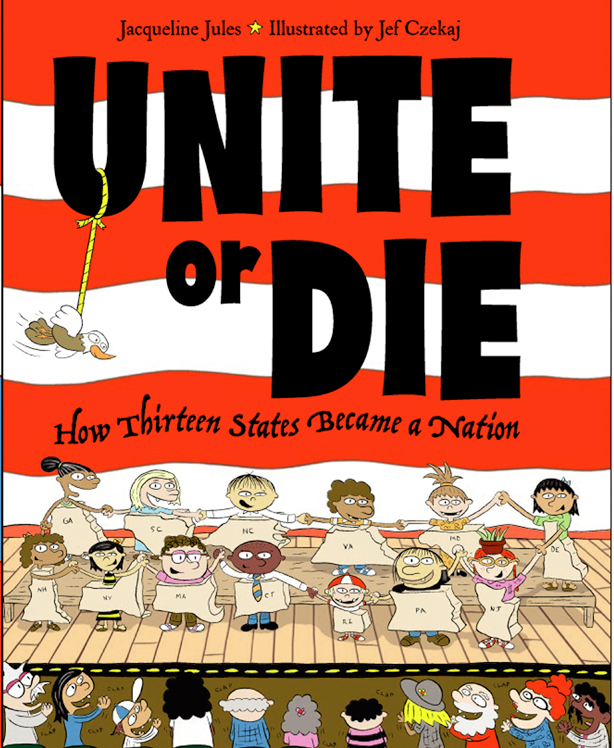

In my book, Unite or Die: How Thirteen States Became a Nation, the students of the imaginary school of Forest Lake Elementary perform a play about the 1787 Constitutional Convention. It is a story which unfolds during a very hot summer in Philadelphia at Independence Hall. Fifty-Five delegates argued bitterly over representation in Congress and at one point, it looked like the convention would break apart. Benjamin Franklin called for prayer and it was said that George Washington looked as glum as he did during the dark days at Valley Forge. The stakes were high. The fledging country was on the brink of collapse. If the delegates had not come up with a compromise, America would not be the nation of fifty states it is today.


The conflicts and compromises of the Constitutional Convention provide a wealth of material for theatrical performance. For a short version of Unite or Die: How Thirteen States Became a Nation, please check out the Reader’s Theater available at this link.


American history is filled with dramatic moments suitable for reader’s theater. And online resources at The National Archives offer primary documents for your students to research and write their own dramatic sketches. Here are some writing ideas with corresponding links.

Idea # 1: The National Archives has a copy of Eleanor Roosevelt’s famous resignation from the Daughters of the American Revolution over their refusal to hold a concert with Marian Anderson at Constitution Hall. A letter in response from the DAR is also available at this link along with information about the historic concert on Easter Sunday in 1939 when Marian Anderson sang to a crowd of 75,000 people at the steps of the Lincoln Memorial.  After examining these primary documents, students could write a radio play with characters playing the part of Mrs. Roosevelt, the DAR president, and Marian Anderson. Reactions from the press and the public could be included.

Idea #2: Transcripts of the Lunar Orbit of Apollo 8 in 1968 are also available online at The National Archives . Students could write an interview with the astronauts describing what they saw and how they felt based on these eyewitness documents.

Idea #3: Susan B. Anthony surprised the registrar in Rochester, New York when she showed up demanding to vote in the 1872 presidential election. The National Archives has primary documents of the hearing which took place after her arrest. Students could re-enact Susan B. Anthony’s historic arrest based on those transcripts.

The Library of Congress also has wonderful resources for primary research. Creating a dramatic sketch based on historical documents is an exciting way to combine research and writing skills.

https://www.archivesfoundation.org/event/write-stuff/
A great opportunity for enhancing those skills will be available at a free literary festival called THE “WRITE” STUFF which will take place at The National Archives this summer on July 7 and 8, 2017. 

On July 7th, students  will have the opportunity to hear a panel of nonfiction authors including John Hendrix, Syl Sobel, Susan Campbell Bartoletti, Tonya Bolden, and myself. Afterwards, students can choose a hands-on workshop with an author of their choice. Information to register is available here.

On July 8, there will be a family literacy, writing, and research festival with featured authors and illustrators including Marty Rhodes Figley, Diane Kidd, Janet Macreery and others. 

Take advantage of these programming and online resources. Enrich your summer with nonfiction writing and research! 

Monday, January 6, 2014

GETTING THE RESEARCH RIGHT

GUEST POST by Catherine Reef

I don’t recall the issue we were debating. It was too long ago, and now it hardly matters. But an idea had been raised in my college sociology class that provoked some heated discussion. At one point a student read a passage from our textbook to support his opinion. The instructor listened and then asked us all, “Do you think the book is right?”

I sat up a little straighter. What was that? Was she suggesting the book might be wrong? The book, that esteemed authority—words printed in black ink and bound in a hard cover—wrong? While the rest of the class argued on, I pondered this startling notion.

As you may have guessed, the most important lesson I learned in Sociology 101 was to be a critical reader. It is one that has served me well as a writer of nonfiction, because again and again in my research I have encountered books that were wrong. I have learned to question, to track down original sources, and to weigh the printed evidence.

I could show how this healthy skepticism has paid off by citing examples from the research that went into nearly every one of my books, including The Brontë Sisters. More than one writer has adopted an authoritative tone, for instance, to write that in 1855 Charlotte Brontë died of tuberculosis, the disease that took the lives of at least four of her five siblings. But how did these authors know this? The answer is that they didn’t; not really. They saw it in another secondary source or jumped to a conclusion after glancing at the facts. The reader or researcher who bothers to investigate Charlotte’s case finds that the cause of her death is uncertain. Her death certificate states that she died of phthisis, a wasting away, but was it due to consumption, as these writers assume, or to the severe intestinal illness that had been plaguing her for weeks? Some authors declare that Charlotte, who was recently married at the time of her death, was pregnant. Charlotte Brontë herself believed this was true, if only because of the severe nausea she was experiencing. Did she actually die of morning sickness, though? It must be noted that the foul water in the Brontës’ village of Haworth was known to carry disease, and a longtime family servant had sickened and died in a similar way only a short time before. So did Charlotte succumb to waterborne contamination? These are all questions I cannot answer. As her biographer, I saw only one way to be honest with my readers and fair to my subject: I described how Charlotte died, but I offered no diagnosis.

So, yes, books can contain factual errors; they can also be wrong, or at least untrustworthy, when it comes to words placed inside quotation marks. Here’s what happens: one writer paraphrases something a subject wrote or said. A second writer repeats the statement word for word and attributes it not to the writer who did the paraphrasing, but to the well-known man or woman whose words were paraphrased in the first place. At some point, as more writers repeat them, the words become enshrined in quotation marks. Content to cite in their endnotes some other secondary source, these writers never check whether the words were ever uttered.

I encountered one of these suspicious quotations when the time came to write about Anne Brontë’s novel The Tenant of Wildfell Hall. Published in 1848, this book was ahead of its time in its frank depiction of alcohol abuse and marital discord. At one point in the narrative, the distraught wife, Helen Huntingdon, bolts her bedroom door against her husband and refuses to let him enter. Now, I am sure such things happened in England in the 1840s, but no one spoke of them above a whisper, and certainly no one wrote of them in a novel. A wife denying her husband access to her bed? Shocking!

“The slamming of Helen Huntingdon’s bedroom door against her husband reverberated through Victorian England,” proclaimed a writer of a later generation, May Sinclair. Or did she? This great quotation appears in a number of critical works, but not one lists a source. Literary detective that I am, I tracked down Sinclair’s actual words in her 1913 book The Three Brontës. And what Sinclair wrote is this: “The slamming of that bedroom door fairly resounds through the emptiness of Anne’s novel.” The second quote is less dramatic than the first, but it is accurate, and it is the one I included in my book, properly sourced. Thus I made a small correction to literary history, but a satisfying one.

Fortunately for us all, authors get their facts right more often than not. Nevertheless, students can be better writers of nonfiction—which is what they are when writing reports or essays—if they read critically. Where did the author get her facts? Check the notes and bibliography. Does he cite primary sources, and is it possible to track them down? Students may not have access to a research library, but many older texts are available online. Do the words “perhaps,” “might have,” and “must have” crop up too often? These are signals that the author is speculating. Students need not be in college to learn to question what they read and to cite printed sources with care.

Because once doubt has been cast on part of a nonfiction work, the rest becomes suspect. We want our readers to trust what we write.
 
   BIO: Catherine Reef has written more than forty nonfiction books for young people and adults, among them The Bronte Sisters: The Brief Lives of Charlotte, Emily, and Anne and Leonard Bernstein and American Music. Her work has earned her the Sydney Taylor Award and the Joan G. Sugarman Children's Book Award as well as Golden Kite and Jefferson Cup Honors. A graduate of Washington State University, she lives in College Park, Maryland. Visit her online at http://catherinereef.com/index.html