Showing posts with label Research. Show all posts

Monday, June 11, 2018

Cooperative Learning with Brave Like My Brother


As a teacher, I was thrilled to discover Brave Like My Brother by Marc Tyler Nobleman. This slim title will make a perfect read-aloud and writing model for the upper elementary classroom. Told entirely in letters, Brave Like My Brother depicts a touching relationship between two brothers writing to each other during World War II. Joe’s letters home to younger brother Charlie share a fascinating account of an American soldier’s life abroad. The portrayal of war is neither too sugar coated nor too frightening for upper elementary students. Charlie’s letters to Joe share his struggles with a bully at home in Cleveland. The book’s large font and 100 page text should make it attractive to reluctant readers. 


Letter writing is a wonderful vehicle for sharing information. After reading Brave Like My Brother, students could work in pairs, each one taking on the role of a person separated from a loved one by war or circumstance. The letters could involve research into either a historical era or geographic region. It could be an exciting cooperative project. Here are some suggestions.

Student 1: Write letters to a sister/brother/friend describing your life as you travel to a new country and build a new life.
Student 2: Describe your life at home in response to these letters.

Student 1: Write letters home to a sister/brother/friend while you are at summer camp or on a vacation.
Student 2: Describe your life back home in response to these letters.

Student 1: Write letters to a friend during a move to a state across the country.
Student 2: Respond to the letters with information on how things are going in your friend’s old city.

Student 1: Write letters to a parent/sister/brother who is away on business, deployed, or incarcerated.
Student 2: Respond to the letters, explaining your current life situation.

Student 1: Write letters to a grandparent asking what life was like for them and explaining what your life is like.
Student 2: Write letters answering your grandchild’s questions.

In an age, when most people communicate by email or text rather than speaking on the phone, the ability to express ourselves by means of a letter is more important than ever. A cooperative letter writing exercise will give your students practice in both writing and essential life skills.


Monday, June 26, 2017

Dramatic Histories & The "Write" Stuff


“If we can’t agree on anything, how can we stay one country?”
“But we could have even bigger problems, if we break apart.”


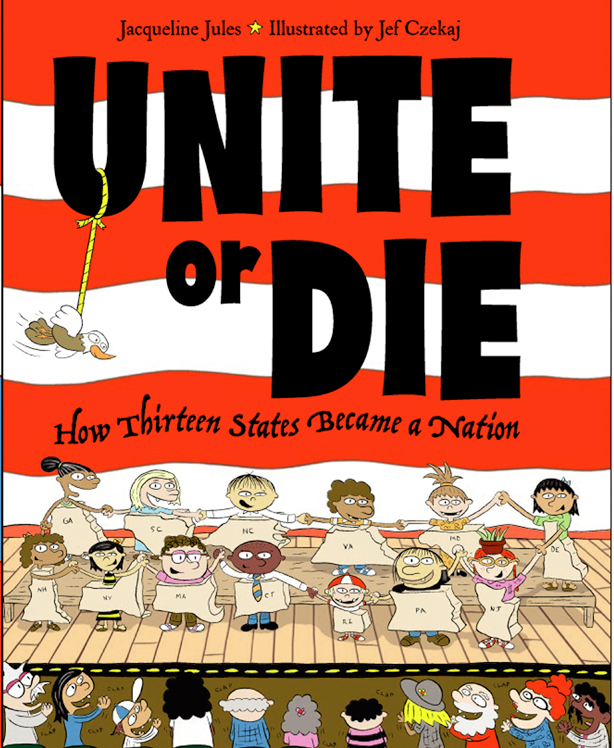
In my book, Unite or Die: How Thirteen States Became a Nation, the students of the imaginary school of Forest Lake Elementary perform a play about the 1787 Constitutional Convention. It is a story which unfolds during a very hot summer in Philadelphia at Independence Hall. Fifty-Five delegates argued bitterly over representation in Congress and at one point, it looked like the convention would break apart. Benjamin Franklin called for prayer and it was said that George Washington looked as glum as he did during the dark days at Valley Forge. The stakes were high. The fledging country was on the brink of collapse. If the delegates had not come up with a compromise, America would not be the nation of fifty states it is today.


The conflicts and compromises of the Constitutional Convention provide a wealth of material for theatrical performance. For a short version of Unite or Die: How Thirteen States Became a Nation, please check out the Reader’s Theater available at this link.


American history is filled with dramatic moments suitable for reader’s theater. And online resources at The National Archives offer primary documents for your students to research and write their own dramatic sketches. Here are some writing ideas with corresponding links.

Idea # 1: The National Archives has a copy of Eleanor Roosevelt’s famous resignation from the Daughters of the American Revolution over their refusal to hold a concert with Marian Anderson at Constitution Hall. A letter in response from the DAR is also available at this link along with information about the historic concert on Easter Sunday in 1939 when Marian Anderson sang to a crowd of 75,000 people at the steps of the Lincoln Memorial.  After examining these primary documents, students could write a radio play with characters playing the part of Mrs. Roosevelt, the DAR president, and Marian Anderson. Reactions from the press and the public could be included.

Idea #2: Transcripts of the Lunar Orbit of Apollo 8 in 1968 are also available online at The National Archives . Students could write an interview with the astronauts describing what they saw and how they felt based on these eyewitness documents.

Idea #3: Susan B. Anthony surprised the registrar in Rochester, New York when she showed up demanding to vote in the 1872 presidential election. The National Archives has primary documents of the hearing which took place after her arrest. Students could re-enact Susan B. Anthony’s historic arrest based on those transcripts.

The Library of Congress also has wonderful resources for primary research. Creating a dramatic sketch based on historical documents is an exciting way to combine research and writing skills.

https://www.archivesfoundation.org/event/write-stuff/
A great opportunity for enhancing those skills will be available at a free literary festival called THE “WRITE” STUFF which will take place at The National Archives this summer on July 7 and 8, 2017. 

On July 7th, students  will have the opportunity to hear a panel of nonfiction authors including John Hendrix, Syl Sobel, Susan Campbell Bartoletti, Tonya Bolden, and myself. Afterwards, students can choose a hands-on workshop with an author of their choice. Information to register is available here.

On July 8, there will be a family literacy, writing, and research festival with featured authors and illustrators including Marty Rhodes Figley, Diane Kidd, Janet Macreery and others. 

Take advantage of these programming and online resources. Enrich your summer with nonfiction writing and research! 

Monday, November 2, 2015

Writing Connections with Jon Scieszka


Make writing and science fun with Jon Scieszka!  His latest book is the third in his zany Frank Einstein series.  In Frank Einstein and the Brainturbo, students can hang out with Frank’s two wacky robot sidekicks and learn about the human body.  In an interviewwith the KidsPost section of the WashingtonPost, Scieszka talks about encouraging curiosity and his favorite facts about the body.

MAKE YOUR OWN HUMAN:  Frank creates a kind of super-charged brain.  As a class, students might create their own human.


Research:  Assign each student a certain part of the human body to research.  Ask each to find and write down three facts for his or her body part.

Writing:  Ask each student to write down two things that might happen if his particular part of the body were super-charged or made bigger or better than real life?  What would that body part then be able to do?  Ask each student to draw a picture of his/her super-charged body part.  What might happen if a villain tried to grab and run away with it?  Why would a villain want it?  How might the student (as a zany kid scientist) save it?

Sharing:  Teacher might have a silhouette of the human body on  the bulletin board, and students might post one or all of their true facts on the bulletin board.  In this way, students can learn about the intricate work of many organs and body parts.


Monday, September 28, 2015

Writing Connections with Science


How to connect writing and science?  Both are important areas for learning for students of all ages.  At the same time that you teach one, you might look for opportunities to reinforce learning in the other.


The website of the publisher of my new nonfiction picture book, Mighty Mole and Super Soil (ages 4-9), features an article with activities related to the book (including making a dirt cake) and Common Core-related projects.

Here are two activities that connect writing with science:

DIRT LETTERS: The United Nations named 2015 the International Year of Soils, in honor of this important resource.  Soil is vital to the health of the planet, but most humans rarely think of it because they can’t see it.
Classroom discussion:  Have students look around the room and out the windows and brainstorm ways that soil is important to life.
Writing:  Young elementary-aged children might choose one of those ways and write and illustrate a letter thanking soil for what it has done/gives and how that particular child has benefitted.  Older children might send their letters to a congressman.
Sharing:  Letters might be posted on a classroom bulletin board, to help celebrate World Soil Day on December 5 (as well as the year-long celebration).   Also the class as a whole might plant a seed or transplant a houseplant into a special pot so that students can feel soil and experience it through many of their senses.  (Chad Wallace brings the underground world to vivid life through his illustrations for Mighty Mole and Super Soil, and students might look at them as they illustrate their letters.)
Playing with Font/Letter Shapes:  Patty Arnold, the book’s designer, worked carefully with the font so that the title and words in the main story look “gritty,” as if they’re fashioned from soil.  As Patty says, the shape and design of the words can help to create a picture and enhance the story.  Students might make some of their words (such as “soil”) look as if they’re made of dirt, perhaps by using a brown crayon when writing that one word.

ARGUE ON PAPER:  Mighty Mole and Super Soil grew out of an ongoing discussion with one of my brothers about moles.  I was Team Mole, appreciating the shy mammal in our backyard.  Moles mix and contribute to healthy soil.  My brother was Team No Mole, irritated by the ridges and molehills in his plush lawn.  He called the mole a pest!  Doing the research to persuade him otherwise gave me the idea to write this book, which I dedicated to him. J
Classroom discussion:  Ask students to list creatures that many people label as pests (specific types of animals or weeds, perhaps).   Why are they considered pests?  What do they do that disturbs humans?
Research and Prep:  Ask students to each choose one of these “pests” and to research its benefits (find at least three).  Then ask them to close their eyes and “become” this pesky animal or plant.  What does it see, hear, smell, taste, and feel?  What is its world like?
Writing:  Continue to pretend to be that pesky animal or plant, and write a letter from it to someone (the world at large, an exterminator, a mole catcher, human parent, etc.) to persuade that person that it is not a pest.  Why should this creature or plant NOT be destroyed or removed?  Have students work in pairs to peer review one another’s work and enhance the persuasiveness.
Share:  Ask for volunteers to share and encourage students to send their letters to the person or to a newspaper editor or organization.

www.maryquattlebaum.com


Monday, July 27, 2015

SWEEPSTAKES, SLOGANS, AND DEATH BY TOILET PAPER

Have you ever thought about slogan writing? Kentucky Fried Chicken is “Finger lickin’ good.” At Burger King, you can expect to “Have it Your Way.” And everyone wants to go to Disneyland because it is “The Happiest Place on Earth.”

In a touching and funny middle grade novel, Death by Toilet Paper, seventh grader Ben loves to enter sweepstakes. He enters as many contests as he can, optimistically hoping to help his widowed mother pay the bills. Slogan contests offer the best chance of winning because not everyone is creative or persistent enough to take the time to write a good advertisement. Ben dreams of winning a big prize from the Royal-T Bathroom Tissue Company. He puts serious thought into a clever slogan in between dealing with a boisterous grandfather, a bully at school, and a best friend who loves horror make-up. And to add to the fun, every chapter begins with a FUNtastic fact about bathrooms. Did you know that most toilets flush in the key of E-flat? Or that Americans use an average of 57 sheets of toilet paper each day?
Death by Toilet Paper by Donna Gephart would make a great read aloud in the classroom. Your students will find Ben to be a lovable and spunky character worth rooting for. The book should also inspire your students to try their hand at slogan writing. Here are some tips to remember:
1.    Brief is better. No more than one sentence long.
2.    Make it catchy. A slogan should have a good rhythm and be easy to say.
3.    Capture the essence. A slogan tells customers why they want the product or service.
4.    Originality is memorable. Don’t recycle old ads. Attract attention with something new.       
And when your class is finished writing their own slogans, maybe your students will want to research some FUNtastic facts about a topic of their choice. Did you know that it takes 384 trees to produce the toilet paper one person uses in a lifetime?

Monday, January 5, 2015

WINTER WRITING IDEAS


Bundling up for an outdoor walk may be time consuming, but it can be worth the hassle, whether you take a field trip to a nearby park or refuge  or just wander the playground or school neighborhood.  Get ready for a winter observation walk by reading Amy S. Hansen’s Bugs and Bugsicles: Insects in the Winter. Youngsters will learn about winter habitats for monarchs, ladybugs and dragonflies but also how Amy creates words like “bugsicles” to describe a woolly bear caterpillar in winter:


“She’s getting ready to perform an amazing trick. She will freeze in the winter, thaw out in the spring, and start all over. Woolly Bear won’t need to breathe while she’s frozen. She isn’t dead. She isn’t really asleep. She’s a bugsicle.”

Now make sure each child has a journal and a good, soft pencil and head outside. Give each child or pair of children a small area to investigate – just a few square yards, like the children in the photo outside the Prairie Wetlands Learning Center in Fergus Falls, MN. (Check the link to see samples of student writing!)

Ask students to use descriptive words to write about their area – what colors do they see? Is there concrete or grass, mud or snow? What do any trees or plants look like?

Are there signs of wildlife? Ask children to imagine where an animal or insect could live in the space they are investigating. Under a log? In a frozen pond? Wrapped in a dry leaf? In the crack in the sidewalk?  

Encourage children to write just single words or phrases that can be turned into poems or prose when everyone is back indoors, where they can also add artwork or research.  There are also several ways to expand this activity:

·       Return in the spring so children can write about changes in the area they observed in the winter. This can be a good “compare and contrast” exercise.

·       Have children write poems about their observations to enter in the River of Words contest. Here is a SAMPLE from Whittlesey National Wildlife Refuge, WI.

·       Partner with a park or refuge to have children write and publish a guidebook, like Bosque del Apache National Wildlife Refuge (NM) Through the Eyes of Children.


Monday, June 2, 2014

DIGGING INTO RESEARCH


Do you like to dig in the sand? Or dig in the dirt in your backyard garden?
When I visit schools, I share research tools that I use as a writer and how I enjoy digging for facts before sitting down to write. I ask students I meet how to research a topic, and the first answer is usually something like this: “Go on the computer,” or “Google it.”
We all rely on our computers for information today, but research is more informative and much more enjoyable, if you step away from the computer and dig deeper to learn about your topic before ever writing a word.

Summer is almost here, so let’s keep this writing exercise as fun as a day on the beach.

Digging Deep: Read, Research, Write

  1. Choose your favorite summer activity to do outside. It might be swimming, playing soccer, or going to the beach. My activity example for this writing exercise is hiking.
  2. Look up five facts about hiking on the computer. Example of one hiking fact: In Australia hiking is called "bush walking" and known as "tramping" in New Zealand. 
  3. Go to your school or town library and find at least three books about your topic. Find at least one new fact you didn’t find in your computer search.
  4. Visit a locale where you can do this activity. I hiked at Bear Mountain when writing my new book These Rocks Count! I also spoke to numerous geologists about rocks.
  5. Talk to an “expert” who knows about your activity. If you love swimming, talk to a swim coach or a swimming instructor at a local pool. For hiking, experts might be trail guides at my local camping store or a forest ranger at a hiking spot in a national or state forest.
  6. Ask this expert if they agree with the facts that you have researched.
  7. Ask them to share something that you might not know from your previous research and helpful advice about your topic. Example from a trail guide about hiking: Always hike with a First Aid kit, packed with extra band-aids for blisters.
  8. Gather your computer, book, and expert fact research. You know much more about your topic now and you are ready to write (a little or a lot) about your favorite summer activity.
Now it’s time for me to swim, hike, dig in the sand, and read lots of books. Whatever you enjoy doing; I hope you have a wonderful summer!


Monday, March 24, 2014

Writing Folktales Author Interview: Nancy Kelly Allen

by Joan Waites

I recently had the pleasure of interviewing author Nancy Kelly Allen about her latest picture book release, FIRST FIRE, (Sylvan Dell Publishing, February 2014, illustrated by Sherry Rogers). Nancy and I have worked on two picture books together in the past, and have remained in touch over the years.

Can you tell us a little bit about your background and path to becoming a children’s book author?
My route to writing children's books is as winding as the mountain roads surrounding my home near Hazard, KY. I began my career as a social worker; then changed paths and taught social studies. From there I ventured into the world of books when I became a librarian. I have a Master's degree in Education from Morehead State University and another Master's degree in Library and Information Science from the University of Kentucky. I have written more than 30 picture books and two middle grade books.  Shhhhhh! Here's a secret to my writing. I have two canine writing muses named Jazi and Roxi that dream up stories and pass them along to me.

What made you decide to tackle a folktale for your latest picture book project?
I’m a retired librarian who has spent an entire career in the elementary school library, so naturally I’ve read my share of folktales…and loved them. My great-grandmother was a Cherokee. Simmering in the back of my mind for over a decade, I’ve considered retelling a Cherokee folktale if I found the right story. I’m always busy working on the next book, so I never actually took the time to track down a Cherokee folktale to retell. Then one day about a couple of years ago, I saw a book about the Cherokee Nation. I checked out all the books I could find on Cherokee stories in our local library. I read many, many stories, but none of them resonated with me the way FIRST FIRE did. It was love at first read.

Did you have a particular publisher in mind when approaching the subject matter?
I did not. I wrote the story and then began researching publishers. I sent the manuscript to two publishers and waited to hear back from them. When I heard, I received acceptance notices within the same week from both. I contacted the second publisher and turned down their offer.

What was your inspiration for writing this particular folktale?
This book is my tribute to my great-grandmother and our Cherokee heritage. As I began reading Cherokee and Native American folktales, I found FIRST FIRE and knew immediately that I wanted to retell it as a picture book. The story had all the elements I was looking for: a variety of animals, a conflict, a crisis, and an unlikely hero, all tied up with a happy ending.

What type of research was involved in writing the story? How did you approach the retelling of the story?
The research was not that difficult. I found the story in different books and versions. The difficult part came with keeping the story authentic and true to the culture. The storyteller in me wanted to tell the story with the most creative flair, but the folklorist in me warned: don’t stray too far from the original story. After all, it was not my story, but a retelling of a Cherokee story. I also spent time reading about the Cherokee culture and talking with members of the Cherokee nation in an effort to give credence to the retelling and to get the details correct.

How might teachers use this folktale in the classroom and for what age group(s)?
Creation stories unravel the mysteries of the origins of the world and/or that of animals and people. Many cultures have their own stories that are similar to the stories of other cultures half-way around the world where the tales developed independently of the other. The stories are sacred and reflect how the people and animals of the culture cope with everyday life. This book can be used in social studies class when studying cultures. It can also be used in science class when studying fire and animals, especially spiders. There is a section in the back of the book designed for educational purposes that is appropriate for primary grades and up through grade five.

What types of writing do you prefer, and why?
I enjoy writing fiction for children. I love the freedom fiction allows. I can be in charge of the fictional world and completely control the plot and characters. I’m Top Dog. The characters say what I tell them to say and do what I want them to do. In the real world, I’m not Top Dog, and I don’t control anyone around me.

I also enjoy writing creative nonfiction. I’ve never outgrown the inquisitive child living inside me. I say “creative” nonfiction because presenting facts and only the facts can be dull and boring. I like to wrap the facts in a narrative that uses literary styles and techniques to make the reader want to keep on turning the pages.


Monday, January 6, 2014

GETTING THE RESEARCH RIGHT

GUEST POST by Catherine Reef

I don’t recall the issue we were debating. It was too long ago, and now it hardly matters. But an idea had been raised in my college sociology class that provoked some heated discussion. At one point a student read a passage from our textbook to support his opinion. The instructor listened and then asked us all, “Do you think the book is right?”

I sat up a little straighter. What was that? Was she suggesting the book might be wrong? The book, that esteemed authority—words printed in black ink and bound in a hard cover—wrong? While the rest of the class argued on, I pondered this startling notion.

As you may have guessed, the most important lesson I learned in Sociology 101 was to be a critical reader. It is one that has served me well as a writer of nonfiction, because again and again in my research I have encountered books that were wrong. I have learned to question, to track down original sources, and to weigh the printed evidence.

I could show how this healthy skepticism has paid off by citing examples from the research that went into nearly every one of my books, including The Brontë Sisters. More than one writer has adopted an authoritative tone, for instance, to write that in 1855 Charlotte Brontë died of tuberculosis, the disease that took the lives of at least four of her five siblings. But how did these authors know this? The answer is that they didn’t; not really. They saw it in another secondary source or jumped to a conclusion after glancing at the facts. The reader or researcher who bothers to investigate Charlotte’s case finds that the cause of her death is uncertain. Her death certificate states that she died of phthisis, a wasting away, but was it due to consumption, as these writers assume, or to the severe intestinal illness that had been plaguing her for weeks? Some authors declare that Charlotte, who was recently married at the time of her death, was pregnant. Charlotte Brontë herself believed this was true, if only because of the severe nausea she was experiencing. Did she actually die of morning sickness, though? It must be noted that the foul water in the Brontës’ village of Haworth was known to carry disease, and a longtime family servant had sickened and died in a similar way only a short time before. So did Charlotte succumb to waterborne contamination? These are all questions I cannot answer. As her biographer, I saw only one way to be honest with my readers and fair to my subject: I described how Charlotte died, but I offered no diagnosis.

So, yes, books can contain factual errors; they can also be wrong, or at least untrustworthy, when it comes to words placed inside quotation marks. Here’s what happens: one writer paraphrases something a subject wrote or said. A second writer repeats the statement word for word and attributes it not to the writer who did the paraphrasing, but to the well-known man or woman whose words were paraphrased in the first place. At some point, as more writers repeat them, the words become enshrined in quotation marks. Content to cite in their endnotes some other secondary source, these writers never check whether the words were ever uttered.

I encountered one of these suspicious quotations when the time came to write about Anne Brontë’s novel The Tenant of Wildfell Hall. Published in 1848, this book was ahead of its time in its frank depiction of alcohol abuse and marital discord. At one point in the narrative, the distraught wife, Helen Huntingdon, bolts her bedroom door against her husband and refuses to let him enter. Now, I am sure such things happened in England in the 1840s, but no one spoke of them above a whisper, and certainly no one wrote of them in a novel. A wife denying her husband access to her bed? Shocking!

“The slamming of Helen Huntingdon’s bedroom door against her husband reverberated through Victorian England,” proclaimed a writer of a later generation, May Sinclair. Or did she? This great quotation appears in a number of critical works, but not one lists a source. Literary detective that I am, I tracked down Sinclair’s actual words in her 1913 book The Three Brontës. And what Sinclair wrote is this: “The slamming of that bedroom door fairly resounds through the emptiness of Anne’s novel.” The second quote is less dramatic than the first, but it is accurate, and it is the one I included in my book, properly sourced. Thus I made a small correction to literary history, but a satisfying one.

Fortunately for us all, authors get their facts right more often than not. Nevertheless, students can be better writers of nonfiction—which is what they are when writing reports or essays—if they read critically. Where did the author get her facts? Check the notes and bibliography. Does he cite primary sources, and is it possible to track them down? Students may not have access to a research library, but many older texts are available online. Do the words “perhaps,” “might have,” and “must have” crop up too often? These are signals that the author is speculating. Students need not be in college to learn to question what they read and to cite printed sources with care.

Because once doubt has been cast on part of a nonfiction work, the rest becomes suspect. We want our readers to trust what we write.
 
   BIO: Catherine Reef has written more than forty nonfiction books for young people and adults, among them The Bronte Sisters: The Brief Lives of Charlotte, Emily, and Anne and Leonard Bernstein and American Music. Her work has earned her the Sydney Taylor Award and the Joan G. Sugarman Children's Book Award as well as Golden Kite and Jefferson Cup Honors. A graduate of Washington State University, she lives in College Park, Maryland. Visit her online at http://catherinereef.com/index.html


Monday, March 25, 2013

MAKE A SPLASH:OCEAN RESEARCH AND WRITING FUN

guest post by Alison Formento

When I write for magazines or newspapers I must fact check all information I include in an article or essay. I conduct interviews and research whatever topic I’m writing about and it’s no different when I write my nature picture books. My books are considered literary non-fiction. There are fictional elements in my stories in which the trees, bees, or seas talk, but every fact shared has been thoroughly researched and verified by scientists and experts, such as apiarists (beekeepers) for my book These Bees Count! and oceanographers for These Seas Count!

My new picture book These Seas Count! was an exciting book to research since our world’s oceans and seas are fascinating and a vital part of keeping our Earth healthy. Scientists have guessed that there are perhaps a million yet-to-be discovered marine life forms. A million! We know so many amazing sea facts such as there are phytoplankton too small to see which help make our air breathable and there are whales the length of several school buses who can communicate in their own language, but imagine what else we don't know yet about marine life. Our oceans and seas are a place of mystery and wonder and we must care for them as we would a garden in our own backyard.

In my research, I discovered underwater coral called Sea Fan and used that as the name for the boat in These Seas Count! Here’s a way students can use research to make a splash in their own writing.
1. Students draw an ocean, beach, and sky scene. Drawing a scene can help inspire creative thinking, especially for those students who may have a hard time getting started on a writing project.
2. Free-write names of sea life that make the beach or ocean its home. Example, write “Whale” in the water part of the picture or “Gull” in the sky part of the picture. The goal is to fill the page with as many of these words as possible to use in drafting an essay.
3. Research books, magazines, educational websites, and ocean links to find a sea creature that you’ve never heard of before, such as the new Zombie Worm recently discovered in the Antarctic Ocean. There are links to several wonderful educational ocean websites on the Educator’s Guide for These Seas Count! (found on my website) including this one: http://oceana.org/en/explore/marine-wildlife.
4. List at least five facts on one new sea creature. Include this new creature on drawing.
5. Use ocean drawing to inspire writing. How does that new creature, like the Sea Fan or Zombie Worm interact with other creatures on the ocean drawing?
6. Write about this creature using the five facts discovered through research. Share information as if writing for someone who has never been to the ocean.
7. Make a splash using personal knowledge of the ocean, along with newly discovered facts, to draft an essay that is both interesting and fun to research, to write, and to read.

Alison Formento is the author of This Tree Counts!, This Tree, 1, 2, 3, These Bees Count!, and These Seas Count! For more about Alison visit her website: www.alisonashleyformento.com

Monday, January 28, 2013

MINI DIARIES FOR WRITING AND RESEARCH

Keeping a mini diary is a fun way to encourage both writing and research. Share Cronin and Bliss’s funny picture books, Diary of a Worm, Diary of a Spider, and Diary of a Fly. First read for enjoyment. Then read it again and ask students to identify what facts they are learning about the animal. Next, invite students to create their own Diary of a…. Here’s how:
1.     Have students choose an animal that they really love.
2.     Take students to the library and let them find books about their animals and/or do web research.
3.     Ask students to create a fact sheet on the animal for reference.
4.     Make a simple blank book by taking four sheets of paper, folding them in half and stapling at the fold with a long-arm stapler.
5.     Invite students to pretend to be the animal and write one diary entry. Students can add illustrations and keep adding entries each day for a week.
At the end of the week, share your diaries.

Sunday, January 16, 2011

PENCIL TIPS WRITING WORKSHOP: CREATING BELIEVABLE AND AUTHENTIC CHARACTERS

by Joan Waites
When presenting to students or adults about the art of picture book illustration, I’m often met with surprise when I describe the amount of research I do when working on any given project. “Don’t you just make it up in your head?” they ask. Oh, if only I could work that type of magic!

As you can see from the photo of my messy desk, taken at the very start of a new picture book project (due out in fall 2012), it is filled with art guidelines from the publisher, photographs, doodles, and even props. This particular book revolves around a main character who was a wealthy plantation owner, living in the 1700’s. But what did he look like? What did he wear? What did his home, his wife, his children and his plantation grounds look like? My job was to make the authors’ characters and story come to life on the page.

After reading the manuscript over and over again and collecting photographs, books on costume, hairstyles, food, and even pictures of children’s toys and plants that would be found at the time and location of the story, I began to develop a sense of who the main character was. His imagined facial features and body type, where he lived, and how he might have dressed was all incorporated into my preliminary sketches. Most often, I will also use live models to pose for me. Family, friends, and neighbors have all appeared and been turned into various characters in my books. Some illustrators have the opportunity to travel to a location to get a better sense of the story they will be illustrating, but of course that is not always possible. Surrounded by all the information on my desk, I can travel into the story and imagine myself there.

Whether the characters are actual historical figures or a fluffy bunny that lives in the meadow, giving the reader a sense of who that character is by written description or in the illustrations is essential. For example, the little bunny that lives in the meadow can be shy, fierce, or lazy. A shy little bunny might be described or shown wearing glasses hidden behind a tree with his nose in a book. The lazy bunny might be a bit overweight, snoozing in grass that is strewn with partially eaten carrots, while other bunnies are shown in the background going about their busy day.

Using these examples, have your students create a believable character using words or pictures. Older children can be assigned a true historical figure or someone fictitious who lived during a particular period in history. Younger students can use an imaginary character to describe and/ or illustrate. Have students collect photos from magazines or the internet, books and props that will give them a sense of who their character really is/was. Using a digital camera, students can also have their classmates dress up and pose for each other, using the printed photos as reference for their drawings.

Using some of these ideas among many others can be a great way to create believable and authentic characters that will come to life on the page!
http://www.joanwaites.com/