Showing posts with label Reader's Theater. Show all posts

Monday, August 20, 2018

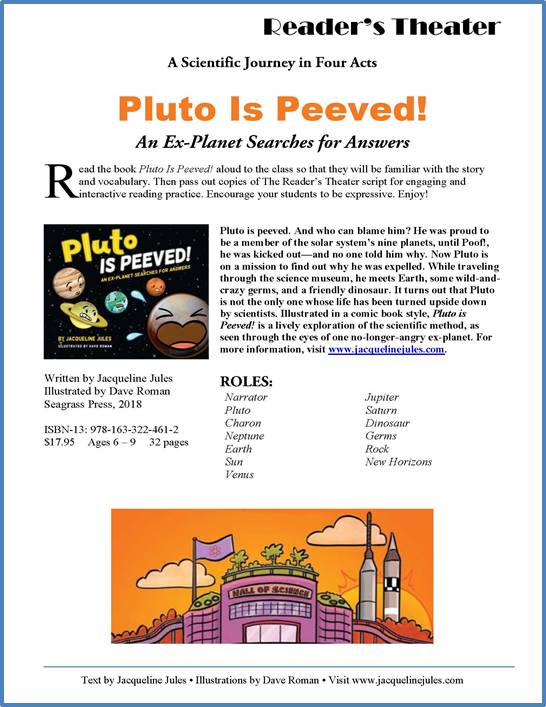
Reader’s Theater for Pluto Demoted Day & Beyond


Did you know that August 24th is Pluto Demoted Day?  That’s the day the International Astronomical Union voted to downgrade Pluto’s status from the ninth planet in our solar system to belong, instead, to a group of dwarf planets in the Kuiper Belt.


In my new book, Pluto is Peeved: An Ex-Planet Searches for Answers, Pluto seeks answers in a museum. After meeting Earth, some wild-and-crazy germs, a friendly dinosaur, and others, Pluto learns that his change in status is not unique in scientific history. Earth was once considered the center of the solar system. The Apatosaurus was originally named Brontosaurus.

After reading Pluto is Peeved with your class, challenge your students to research and write about scientific breakthroughs such as how Anton van Leeuwenhoek first saw tiny wiggling “animalcules” through a microscope in the 1670’s or how Louis Pasteur proved it was possible to kill germs through a heating process now known as pasteurization.  

Illustrations by Dave Roman

Scientists make observations and question everything—even ideas people have long considered to be facts. They spend years researching and collecting data. When new evidence is discovered, scientists present discoveries to the world, expanding our knowledge of the universe. Other topics your students can investigate include: The Fate of the Dinosaurs, The Center of the Solar System, The Discovery of Radium, Penicillin, or DNA, Plate Tectonics, and the New Horizons Space Mission. For a list of 11 Innovations That Changed the World see this list from The History Channel.

When research is completed, challenge your students to write a Reader’s Theater script in which one scientist describes his/her discovery to another person. Will the discovery be received with excitement or skepticism or confusion? Dialogues your students write could include spirited discussions.  

Reader’s Theater is a fun, interactive tool for developing oral reading skills and reading fluency. When your students have the opportunity to write their own scripts, it doubles the fun. In addition, a Reader’s Theater based on research can integrate science into the language arts curriculum.


For an example of a science-based Reader’s Theater, please visit my website and download a Reader’s Theater for Pluto is Peeved.

Enjoy!


Monday, July 24, 2017

In Pursuit of Civil Conversation

Guest Post by Mary Knight
author of Saving Wonder, winner of the 2017 Green Earth Book Award

As I’ve traveled to schools for author visits since the publication of my debut novel, Saving Wonder, teachers have been telling me how concerned they are about the divisive rhetoric their students are witnessing from our country’s leaders. 


In the spirit of encouraging the practice of civil conversation, I’ve created the following lesson, which invites students to activate their empathy as they see an issue from the “other’s” point of view. It also offers practice in close reading, as well as writing dialogue within a scene. I use Saving Wonder as a model text in this lesson, although I’m sure examples of civil dialogue exist in other novels as well.

In Saving Wonder, my protagonist Curley Hines has a conversation with the new coal boss (Mr. Tiverton) who is threatening to blow the top off his mountain through a devastating mining process called mountaintop removal. A lot is at stake for both characters, but they nevertheless have a civil (albeit passionate) conversation that allows each to express his point of view.

The following is an abbreviated lesson with a corresponding writing prompt. It assumes that students have at least read up to Chapter “P.” If you’d like an extended version with a fun, optional activity, please contact me through my message page at my website: www.maryknightbooks.com. I’d love to hear what you think and if you use the lesson, your results!

A Lesson on Civil Dialogue

Before engaging the lesson, explore the concept of “empathy” with your students. Say: One of the ways authors inspire readers to care is by writing with empathy. Does anyone know what empathy is? Empathy is the ability to walk in another person’s shoes, to see the world through another person’s eyes or point of view, or to imagine what another is feeling. You can empathize with someone who is feeling happy or sad or any other emotion. Invite students to think of examples from their own lives where they’ve empathized with another person or animal (pet).

Before reading and/or rereading Chapter “P,” pgs. 154-163, ask: Do you think Mr. Tiverton is a “bad guy” in this novel? Ask for a show of hands, yes and no. Then ask: Why do you think that? Be sure to remain neutral. After opinions have been expressed, invite your class to reread the following, saying: Let’s (re)read the following chapter and see what our thinking is then.

Read and/or reread the scene.
After reading: On a T-chart, title the page: “Red Hawk Mountain.” Under that, make two columns: one titled “Curley’s Viewpoint” and one titled “Mr. Tiverton’s Viewpoint.” Use a different color for each point of view. Ask students to first list what Curley thinks and feels about mining Red Hawk Mountain and the mountain itself, referring to the text as often as they like. Invite them to do this by “empathizing” with Curley, by putting themselves in his shoes.

After this feels complete, facilitate the same process with Mr. Tiverton. Be sure to invite students to step into the shoes of Mr. Tiverton. How does he see Red Hawk Mountain? What does he think and feel about the mining process? Again, invite students to refer to the text as often as they like.

After you’ve completed this exercise, ask again: So, who thinks Mr. Tiverton is a bad guy? Why or why not? It’s okay for students to still hold the opinion that he’s a bad guy. That’s not a wrong answer; it’s an opinion. Ask: Regardless of what we think of Mr. Tiverton, do you understand his viewpoint a little bit better after stepping into his shoes? When we empathize with someone, it doesn’t necessarily mean that we agree with them, right? Still, empathy can help us understand someone else’s viewpoint, an important skill in a world with lots of different perspectives.

Reader’s theater: If there’s time, “play out” this dialogue (pgs. 158-163) between the two perspectives through a Reader’s Theater activity, encouraging each actor to look at the chart and “step into the shoes” of his or her character, “seeing what he sees” and “feeling what he feels.” Encourage them to: “Read from the heart of your character—like you are passionate about everything you are saying!” Reading with empathy encourages fluency!

After Reader’s Theater, ask the actors: How did it feel to play your part? Is there anything more you understand about your character after speaking his words?

Ask the rest of your class: After watching and listening, do you feel any different about Mr. Tiverton now? In what ways does the author help us empathize with each of her characters?

Writing with empathy: Using the above dialogue scene as a model text, ask students to: Write a scene like the one we’ve just acted out, where you and a parent, a sibling, a teacher or a friend are having a conversation about something that means a lot to you . . . and the other person holds a different perspective or opinion than yours. Offer examples of family or school issues students might want to explore in their writing.   

Once students have decided on their “issue,” ask them to create a T-chart—two columns on a sheet of paper, one representing the writer / narrator’s viewpoint and the other column representing the viewpoint of the other character in their story. Encourage them to “step into the shoes” of each character and write down each character’s feelings as well as ideas and thoughts about this issue. 

Ask students to write at the bottom of this brainstorming page, where the conversation is taking place and whenAfter they’ve done this pre-writing activity, invite them to write a scene between themselves and another person using dialogue that explores two different points of view.


Bio: Saving Wonder is Mary’s debut novel, published in 2016 by Scholastic Press, and selected for numerous honors, including the Green Earth Book Award for Children’s Fiction, a Parents’ Choice award, and a Children’s Book Council Notable Book for Social Studies. Mary is also working on a professional development book called, CoreEmpathy: Transforming the Literacy Classroom, with her writing partner and literacy specialist, Christie McLean Kesler. www.CoreEmpathy.com  

Monday, June 26, 2017

Dramatic Histories & The "Write" Stuff


“If we can’t agree on anything, how can we stay one country?”
“But we could have even bigger problems, if we break apart.”


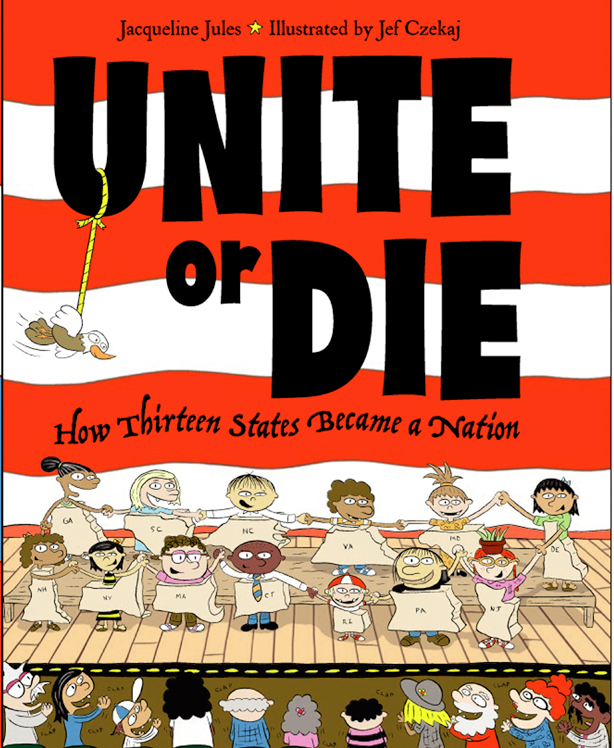
In my book, Unite or Die: How Thirteen States Became a Nation, the students of the imaginary school of Forest Lake Elementary perform a play about the 1787 Constitutional Convention. It is a story which unfolds during a very hot summer in Philadelphia at Independence Hall. Fifty-Five delegates argued bitterly over representation in Congress and at one point, it looked like the convention would break apart. Benjamin Franklin called for prayer and it was said that George Washington looked as glum as he did during the dark days at Valley Forge. The stakes were high. The fledging country was on the brink of collapse. If the delegates had not come up with a compromise, America would not be the nation of fifty states it is today.


The conflicts and compromises of the Constitutional Convention provide a wealth of material for theatrical performance. For a short version of Unite or Die: How Thirteen States Became a Nation, please check out the Reader’s Theater available at this link.


American history is filled with dramatic moments suitable for reader’s theater. And online resources at The National Archives offer primary documents for your students to research and write their own dramatic sketches. Here are some writing ideas with corresponding links.

Idea # 1: The National Archives has a copy of Eleanor Roosevelt’s famous resignation from the Daughters of the American Revolution over their refusal to hold a concert with Marian Anderson at Constitution Hall. A letter in response from the DAR is also available at this link along with information about the historic concert on Easter Sunday in 1939 when Marian Anderson sang to a crowd of 75,000 people at the steps of the Lincoln Memorial.  After examining these primary documents, students could write a radio play with characters playing the part of Mrs. Roosevelt, the DAR president, and Marian Anderson. Reactions from the press and the public could be included.

Idea #2: Transcripts of the Lunar Orbit of Apollo 8 in 1968 are also available online at The National Archives . Students could write an interview with the astronauts describing what they saw and how they felt based on these eyewitness documents.

Idea #3: Susan B. Anthony surprised the registrar in Rochester, New York when she showed up demanding to vote in the 1872 presidential election. The National Archives has primary documents of the hearing which took place after her arrest. Students could re-enact Susan B. Anthony’s historic arrest based on those transcripts.

The Library of Congress also has wonderful resources for primary research. Creating a dramatic sketch based on historical documents is an exciting way to combine research and writing skills.

https://www.archivesfoundation.org/event/write-stuff/
A great opportunity for enhancing those skills will be available at a free literary festival called THE “WRITE” STUFF which will take place at The National Archives this summer on July 7 and 8, 2017. 

On July 7th, students  will have the opportunity to hear a panel of nonfiction authors including John Hendrix, Syl Sobel, Susan Campbell Bartoletti, Tonya Bolden, and myself. Afterwards, students can choose a hands-on workshop with an author of their choice. Information to register is available here.

On July 8, there will be a family literacy, writing, and research festival with featured authors and illustrators including Marty Rhodes Figley, Diane Kidd, Janet Macreery and others. 

Take advantage of these programming and online resources. Enrich your summer with nonfiction writing and research! 

Monday, November 19, 2012

THANKSGIVING FOOD FIGHT!

by Jacqueline Jules

At Thanksgiving time, many classrooms enjoy persuasive writing. A very popular writing prompt is the DON’T EAT ME letter where students take on the persona of a turkey trying to convince the farmer to spare him from the chopping block. Students have a blast explaining why they are too scrawny or tasteless to eat. Since these pleas are written in letter form to a fictional Farmer Brown, there is an opportunity to review proper letter form in the process.   


A variation on this theme would be to ask students to write dialogues between foods sitting on a Thanksgiving table. Each food could explain why it is important to the holiday meal and/or the favorite of the family sitting down to eat. Descriptions of foods always provide great opportunities to incorporate the five senses. Does the food crunch in your mouth? Does it have a particular texture or taste on your tongue? What does it smell like?

The conversations between the foods could be playful or serious. The cranberry sauce could argue with the green beans over who is the most colorful or nutritious. The turkey could be a big bully who makes the other foods cry until the crescent rolls decide to take a stand. Maybe the pumpkin pie has an argument with the pecan pie and all the foods pick sides. The possibilities for creative dialogue are endless and students may have great fun performing their finished pieces as Reader’s Theater. For tips on giving each character in a conversation a distinctive voice, check out Mary Quattlebaum’s post on Two-Person Dialogue poems 
  
And of course, don’t miss this opportunity to review grammar rules for writing dialogue. Many students neglect to begin a new indented line for each speaker or put punctuation inside the quotation marks.


Finally, please note that I said students should write dialogues between foods on the Thanksgiving table, rather than traditional Thanksgiving foods. Many first generation immigrant families, like the character of Tuyet, in my Thanksgiving picture book, Duck for Turkey Day, serve a holiday meal native to their birth country rather than turkey and stuffing. Writing about holiday foods from other countries and sharing their descriptions could become a lesson on diversity in your classroom. We need to remember that not everyone celebrates Thanksgiving in the same way and too much emphasis on turkeys can be uncomfortable for some children. On this theme, I wrote a song about foods on the Thanksgiving table that you are welcome to share with your students. This song, “A Holiday for All,” is set to the tune of Shortin’ Bread. Maybe your students will want to create their own lyrics to a familiar tune in honor of Thanksgiving, too.

 www.jacquelinejules.com

Monday, July 23, 2012

READER'S THEATER (Part 2)


In my last post (June 4, 2012), I mentioned Reader’s Theater as a great motivator for classroom reading and writing.  And since this is summer, it can also be a playful camp or family experience. Both the group performance and no-need-to-memorize aspects take the stress out of the reading/performing experience for most kids.

And they also love the writing part.

Storyteller/children’s author Aaron Shepherd offers detailed tips on adapting a picture book or story for Reader’s Theater. Here are the basic steps:  

1.  Look for a book (or scenes) with dialogue, action, and a number of characters.  Are there places where you might “create” a role to be filled by a large number of kids so that everyone might participate, not just the relatively fewer kids with bigger roles as primary characters.  A pet who makes noises, perhaps?  A crowd that repeats a particular refrain?  Or a repeating sound effect?

2.  Break kids into teams of 2 or 3 people each.

3.  Assign each team a section of the story.

4.  Have them identify narration vs. dialogue and then identify each bit of dialogue as belonging to a specific character.

 5.  Assign roles of narrator(s) and various characters.

6.  Read and have fun!

But how, you might ask, are students doing any writing if, essentially, they are adapting an already written text?

1.  They are learning to read more analytically for certain elements, in this case dialogue, narration, and gesture.

2.  They are making careful choices as to what/how/how much to include (for example, details of setting or characterization).

3.  They might take a story they’ve written earlier in the year and adapt it for Reader’s Theater, gaining insight into how to improve that first story in the process.

Adults writing for children can also benefit from #3, learning to create more dynamic picture books and stories by examining, performing, and then revising the dialogue/story in various drafts.

I recently saw a performance of a powerful book of poems, I Lay My Stitches Down by Cynthia Grady (Eerdmans 2012).  These poems are in the voices of fictional slaves of the 19th century, which students took on at the middle school where Grady is a librarian. The resulting performance was stunning.


Monday, June 4, 2012

READER'S THEATER (Part 1)


These last weeks of school are tough for student and teacher alike.  The kids are dreaming of summer plans, but teachers are still hopeful of imparting a few lessons before break.  Enter: Reader’s Theater.

Basically, Reader’s Theater is a group of people giving a dramatic reading of a script or book.  Lines are not memorized.  And there’s no need for props, costumes, special lighting, numerous rehearsals, or an audience (though they can all add to the fun).  An added bonus:  students in classrooms that regularly do Reader’s Theater often report an increased interest in reading and demonstrate enhanced reading and speaking skills.  It’s a great way for shy children to participate without feeling on the spot and for class “hams” or “clowns” to get positive attention while working toward a common class goal.

I first became acquainted with the power of Reader’s Theater many years ago while teaching creative writing in a summer camp for remedial students (ages 9-11).  They did not want to read and write, which they experienced as “boring” and “stupid” activities.  But they did like connecting (flirting, chatting, arguing) with the other kids there.  So, how to harness all this great verbal and potentially collaborative and creative energy?

I wasn’t familiar with the concept of Reader’s Theater, alas, but in desperation began having the kids work in small groups to write and perform dialogue poems (see my January 30, 2012 post on Dialogue and Two-Person Poems).  The kids loved the performance aspect and were soon writing and revising more carefully in order to perform their best work.  From there, they wanted to read-perform or essentially do Reader’s Theater with longer works and even wrote their own scripts (more on how to develop writing activities out of Reader’s Theater in Part 2, my next post in July).

If you’re looking for helpful books, scripts and resources, check the website of author/storyteller Aaron Shepherd. http://www.aaronshep.com/rt/  It includes more than 20 scripts, ranging in suitability from grades 1 to 10, that can be printed and used for free in the classroom.