Showing posts with label Reading. Show all posts

Monday, March 7, 2016

Writing Connections with Gene Luen Yang


Gene Luen Yang recently became the fifth National Ambassador for Young People’s Literature, succeeding Kate DiCamillo.  As the first graphic novelist in this prestigious role, he brings a keen awareness to the interplay of words and art in the creation of engaging stories.  In a recent interview for the KidsPost section of the Washington Post, Yang talked about his passion for reading and creating comics as a kid, and the way that books can connect people and help them to explore new worlds.
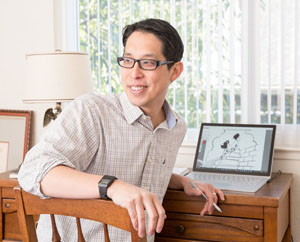


The following writing prompts and discussion points connect to Yang’s platform “Reading Without Walls” for the two years of his ambassadorship.

Classroom Discussion:  Yang suggests that young people explore new worlds in two ways: (1) read a book on a topic completely new to them, and (2) pick up a book about a character who is different (by race, gender, culture, etc.) from them.  Have each student brainstorm topics, coming up with a list of at least five new subjects to explore.  Or have them visit the library and check out a book with a completely new type of character.

Writing:  Ask students to read their books and then write a short response paper.  What did they learn by reading this?  What, exactly, was boring?  What was surprising?  Would they want to learn more?  Why or why not?


Classroom Discussion:  In his graphic novel, American Born Chinese, Yang draws on some of his own experiences as one of the few Asian-American kids in his middle school.  He was sometimes teased and excluded.  Writing:  Ask students to write about a time when they felt teased or excluded.  Was it because of appearance, socioeconomic status, race?  How do they feel about the incident now?  (These should remain private unless the writer wants to share aloud.)

Additional Resources:  The Library of Congress website includes information on past and current  National Ambassadors of Young People's Literature.

Check Yang’s website  for details about his work as a writer for DC Comics and his graphic novels, including Boxers & Saints and the playful, tech-savvy Secret Coders middle-grade series.   


Monday, December 21, 2015

THE WHOLE BOOK APPROACH


In the newly released book, Reading Picture Books With Children, by Megan Dowd Lambert, (Charlesbridge 2015), Lambert introduces The Whole Book Approach-an alternative to traditional story time.


Instead of reading books TO children, she emphasizes using the picture book as a visual art form, engaging children to participate in what they see and hear.

The chapters are broken down into the different parts of a picture book that make up the whole. The author gives examples of questions to ask students that engage them into looking beyond the surface of what they see. Some of the chapters include information on trim size and orientation, jackets and covers, endpapers, front matter, typography, page design, as well as other artistic and design choices that were made to compliment the story. These design elements might not be seen or realized at first glance, and coaxes the reader to explore them further.

The whole book approach can be used by parents, caregivers, teachers, librarians and even authors and illustrators when doing school presentations.

As the book cover says, “shake up story time and get kids talking about what they see.”

Happy Holidays and Happy New Year to all!


Monday, February 16, 2015

LIBRARIES RULE!

guest post by Sue Fliess

Not that you needed a good reason to talk about the importance of libraries, but just in case you were looking for one…Books for Me! is the rhyming story of a young Hippo girl and her Dad going on an outing to their local library to find great books. This book is the third adventure with our young Hippo, illustrated once again by Mike Laughead. In Shoes for Me!, she makes a trip to the shoe store with Mom to pick out a pair of new shoes. In A Dress for Me!, she gets to choose a new dress. When I do school visits, I always get a plethora of wonderful suggestions for more “for me” adventures for Hippo. See what your class comes up with…I’d love to hear them!

Books for Me! is about the joy of discovering all kinds of books—adventure, science fiction, mystery, history, folktales, non-fiction—and how a library is the perfect place to do it. It’s an opportunity to talk to kids about fiction versus non-fiction, the different sections of the library, and what a librarian does. Get them thinking about what kinds of books they are drawn to—help them discover their favorite genre. 

Another fun activity you can do with your students as you read this book to them is to talk about rhyme. Ask them to help you finish the sentence and talk about the rhyme they hear at the end of the stanzas. For example: “Lots of choices I can see. Will I find some books for me?”

Have your students help you write a rhyming poem. I usually have kids fill in the last word of the alternating line or lines. Here’s an example:

Winter is cold, but snow is fun.
Summer is hot from the yellow _____.

In addition, you could have your students try their hand at their own poem, rhyming or otherwise. The idea is to get them thinking of their own stories and writing them down.

See if your class can identify some of the books that have been worked into the illustrations and the text, such as “Books on mittens (The Mitten by Jan Brett), broken chairs, mice and moons (Goodnight Moon by Margaret Wise Brown) and puzzled bears (The Three Bears).” They will likely recognize many. If possible, have these books on-hand also, so they can see how the covers were included in Books for Me!

Questions you can ask: 
What is rhyme? 
Can you give an example of some rhyming word pairs?
What’s your favorite book/story? Is it fiction or non-fiction?
Name one thing you learned from a book this year.
What’s your favorite part about the library?
Why do we go to the library? (no wrong answer here J)

If we can help kids see now that libraries are windows to the big world they’re in, they’ll develop a lifelong love of reading.  

Bio: Sue Fliess ("fleece") is the author of eighteen children's books (published or forthcoming) including Tons of Trucks, Robots, Robots Everywhere!, How to Be a Superhero, and most recently, The Hug Book and Books for Me! Her background is in copywriting, public relations, marketing, and event planning, and her articles and essays have appeared in O,the Oprah Magazine, Huffington Post, Writer's Digest, Education.com, Daily Candy Kids, Travelmuse.com, and more. Fliess's picture books have received honors from the Society of Children's Books Writers and Illustrators (SCBWI) and have been used as curriculum teaching tools in elementary school classrooms as well as children's educational programs in museums. She's an active member of SCBWI, the Children’s Book Guild of D.C. and The Author’s Guild. Sue lives in Northern Virginia with her husband, two boys, and a Labrador puppy named Charlie. Visit her online at www.suefliess.com

Monday, December 30, 2013

BEST CHILDREN'S BOOKS 2013


It’s hard to believe another year is drawing to a close, and 2013, in particular, seems to have been a very good year for children’s books.  Just a few short years ago, everyone speculated on the eminent death of the printed book as tablets and e-readers were introduced to the market.  Fortunately for book creators and book lovers alike, the printed book is still very much alive and well. Below is a sampling of some of the “best of” lists. What were some of your favorite titles of 2013?


Happy Reading!


Monday, December 16, 2013

A LONG WINTER’S READ


I don’t know about you, but the approach of the holiday season puts me less in the mood for penning and more in the mood for reading. As I madly grade student essays and meet deadlines in my own writing life, I find I just want to nestle all snug in my sofa cushions while visions of fictional characters dance in my head.

I’ve made a point to share this particular longing with my students lately, because I think this poor “Social Media Generation” is losing the ability to focus on text for more than a couple of minutes at a time. That is, in fact, what they wrote about in their semester-ending essays: the effect of technology on their lives. Guess what I’m finding as I read these? The very students who seem most tied to their electronic devices are upset about such things as not being taught to write (or read!) cursive. They recognize that their time is being sucked away from them by their smartphones, and that being the generation with the most dexterous thumbs is probably not going to prove to be much of an advantage in the long run. Many of these eighteen- and nineteen-year-olds still value books, I’m seeing, even as they are convinced they have no time to read them.

So, I’ve been looking at book lists lately, trying to come up with good suggestions to help these multi-taskers unplug and read for pleasure. Here are some links that I’m finding to be good places to start:

Goodreads is trusted by young folk because the lists are created by young folk. This is a page with their college-agerecommendations.

American Library Association is a tried and true source for lists for all ages. Here is their 2013 BestBooks for Young Adults.

And because even teenagers cherish memories of children’s classics—especially around the holidays—here is New York Public Library’s all-time “Top 100.”

Happy winter solstice to all, and to all a good book!


Monday, June 4, 2012

READER'S THEATER (Part 1)


These last weeks of school are tough for student and teacher alike.  The kids are dreaming of summer plans, but teachers are still hopeful of imparting a few lessons before break.  Enter: Reader’s Theater.

Basically, Reader’s Theater is a group of people giving a dramatic reading of a script or book.  Lines are not memorized.  And there’s no need for props, costumes, special lighting, numerous rehearsals, or an audience (though they can all add to the fun).  An added bonus:  students in classrooms that regularly do Reader’s Theater often report an increased interest in reading and demonstrate enhanced reading and speaking skills.  It’s a great way for shy children to participate without feeling on the spot and for class “hams” or “clowns” to get positive attention while working toward a common class goal.

I first became acquainted with the power of Reader’s Theater many years ago while teaching creative writing in a summer camp for remedial students (ages 9-11).  They did not want to read and write, which they experienced as “boring” and “stupid” activities.  But they did like connecting (flirting, chatting, arguing) with the other kids there.  So, how to harness all this great verbal and potentially collaborative and creative energy?

I wasn’t familiar with the concept of Reader’s Theater, alas, but in desperation began having the kids work in small groups to write and perform dialogue poems (see my January 30, 2012 post on Dialogue and Two-Person Poems).  The kids loved the performance aspect and were soon writing and revising more carefully in order to perform their best work.  From there, they wanted to read-perform or essentially do Reader’s Theater with longer works and even wrote their own scripts (more on how to develop writing activities out of Reader’s Theater in Part 2, my next post in July).

If you’re looking for helpful books, scripts and resources, check the website of author/storyteller Aaron Shepherd. http://www.aaronshep.com/rt/  It includes more than 20 scripts, ranging in suitability from grades 1 to 10, that can be printed and used for free in the classroom.


Monday, April 23, 2012

Connecting with Writing


What books might help to create a bridge from reading to writing?  Which ones might help students to connect with writing as a meaningful activity in their own lives?

Recent posts by fellow Pencil Tippers Jacqueline (April 9, 2012, “Tips for Writing Poetry”) and Alison (March 19, 2012, “The Reading/Writing Connection”) got me thinking about the two questions above.

Too often students (kids, especially) don’t see writing as particularly relevant to their lives.  They’ll go through the motions of writing essays or persuasive letters but rarely realize, until they’re older, how such writing sharpens their analytical and organizational skills.  As teachers, though, we recognize the value of such writing and work to ensure that our students learn these skills.

But sometimes, especially with reluctant writers and readers, it helps to sweeten the writing pot a bit.  To give students a chance to try their hand at writing that might have a more immediate connection.

I’m talking poetry.

Students rarely seem to read poetry on their own, but when guided to explore certain elements in a poem (imagery, sound, emotion), they are quick to discuss—and often to draw connections to their own lives.

Alas, too often, young people come to poetry with preconceived notions:  a poem must rhyme and be about elevated subject matter (love, beautiful things).  To counter those notions, I’ve found it helpful to share two particular books:

Honey, I Love by Eloise Greenfield, illustrated by Diane and Leon Dillon (HarperCollins).  First published in 1971, these free-verse poems in the voice of a young girl reflect on jump roping, train riding, and the people and things that she loves.  The subject matter and style are kid friendly and accessible.  Kids discussing the poems often mention their liking for some of the same things and then write of the small joys in their own lives—and eagerly share their poems aloud.

Guyku by Bob Raczka, illustrated by Peter Reynolds (Houghton Mifflin).  These haiku on puddle splashing, stone skipping and tickly grasshoppers encourage kids to think about details and imagery and dispense with rhyme.

Monday, May 30, 2011

PLOTTING A VIDEO GAME

by Pam Smallcomb

As the mom of three boys, I know that getting a boy to read a book can sometimes be a challenge. Getting some boys to write, well, it might be easier to just go outside and move a mountain. I have found one topic that has never failed to excite interest when I talk to boys: gaming. I’ll go out on a limb here and say that most boys over the age of six are well versed in the gaming culture. They not only know the games out there, but are playing a good deal of them in their spare time.

So how can you translate this excitement for gaming into a writing experience, while limiting explosions, weaponry and other assorted violence?

How about having them design a game setting? Defining the setting as a stand-alone task has its advantages. It takes the narrator/character out of the writing (and the weapon temporarily out of his hands). By focusing the writing on describing the world of their imaginary game, they will learn the valuable skill of creating a story ‘bible.’ There are many appealing aspects to video games. Their scenes are richly landscaped. There are distinct cultures and hierarchies. Different realms operate by different rules. Just ask anyone who plays WOW (World of Warcraft, for the uninitiated).

Some questions to ask your students about their gaming environment could include:

Will there be any environmental obstacles that your characters will have to overcome?
What kind of lives do the different characters live (different professions, etc.)?
Do the characters live in different realms? What are they?
Are there any traditions? Taboos?
If I were to walk into a market or meeting place within your game setting, what sounds would I hear? What would people be eating?
What does it look like (the actual landscape)?
Where are we in time?
Do they have any magic? How does it work?
What scientific gizmos do they have? For example, can they teleport?

Within every game, there are groups of characters, or ‘tribes’ that need defining. Some questions about the general characters that inhabit the different gaming realms could be:

What do the different groups of characters look like? What is their temperament?
Any monsters among them? What kind?
Are some characters  ‘more equal’ than others?
Are there grudges and prejudices among the different characters?
What skills are valued?
Are there rules that must be obeyed?
Are there boons to secure? Missions or quests to complete?
And the one they will like best: How do they protect and defend themselves?

Once the general game setting has been written, you can then ask your students to continue their gaming ‘bible’ and define the specific characters who will take the lead in their game, and of course, describe the point (or story) of their game.

As the student defines his gaming world, hopefully the story of the game will become clearer. If this sounds like the steps you would take to plot a fantasy or a science fiction novel, that’s because it’s very similar. But the good news is, your gamer doesn’t have to know that.


http://www.pamsmallcomb.com/index.html