Showing posts with label Writing Process. Show all posts

Monday, June 19, 2017

Writing Connections with Kelly Barnhill


Kelly Barnhill’s atmospheric novel The Girl Who Drank the Moon won this year’s Newbery Medal.  In an interview with the KidsPost section of the Washington Post, Barnhill talks about trying to create nuanced characters and her desire for a pet dragon as a kid.

Below are writing lessons for the classroom or for individual writers ages 8 and up.  Barnhill’s website has a hilarious FAQ about her writing process and information on her other books.


CREATING CHARACTERS:  Exploring Stereotype:  Barnhill’s novel is full of witches, who are usually presented as problematic in most books. Witches often are the villains or antagonists in fairy tales, for example.  Barnhill said that she wanted to push beyond the usual stereotype of the witch as mean (even evil), old, homely, and solitary.  Her witch characters are unique individuals, with a mix of positive and negative traits.

Classroom Discussion:  Have kids read the novel and make a list of the positive and negative traits for some of the witches.

Classroom Discussion and Writing:  Have students think about a character in a fairy tale or story that is usually presented in a stereotyped way.  The wolf in “The Three Little Pigs” or “Little Red Riding Hood,” is an example of a character that is usually presented only with negative traits.   The princess (“Cinderella,” “Snow White”) is usually presented with only positive traits.  Ask students to read their fairy tale carefully and list traits of this character or what they learn about the character from this tale.  Then ask them to give this character 1 or 2 traits that are the opposite of what they listed.  For example, the wolf might be listed as “nurturing” or Cinderella as “lazy.”  Ask students to write a story or even just a short scene to show this character with at least one positive and one negative trait.

An Unexpected Character:  We usually think of dragons as large fierce characters but the young witch’s pet in Barnhill’s novel is a tiny bossy dragon.  Classroom Discussion:  Ask kids to list some the physical and psychological traits of one of their favorite animals.  Then ask them to change one or two of the traits to its opposite (for example, from “big” to “small” of from “cuddly” to “fierce”), and in this way the character becomes fresh and unexpected.  Classroom Writing:  Ask students to create a story about or that includes such an unexpected pet.   Perhaps the unexpected pet is even the main character!  What happens next?

Ask a few students to volunteer to read their pieces aloud.  As a group, discuss what they learned about creating more nuanced or well-rounded characters and unexpected pets.


Monday, February 13, 2017

"If I" Poem


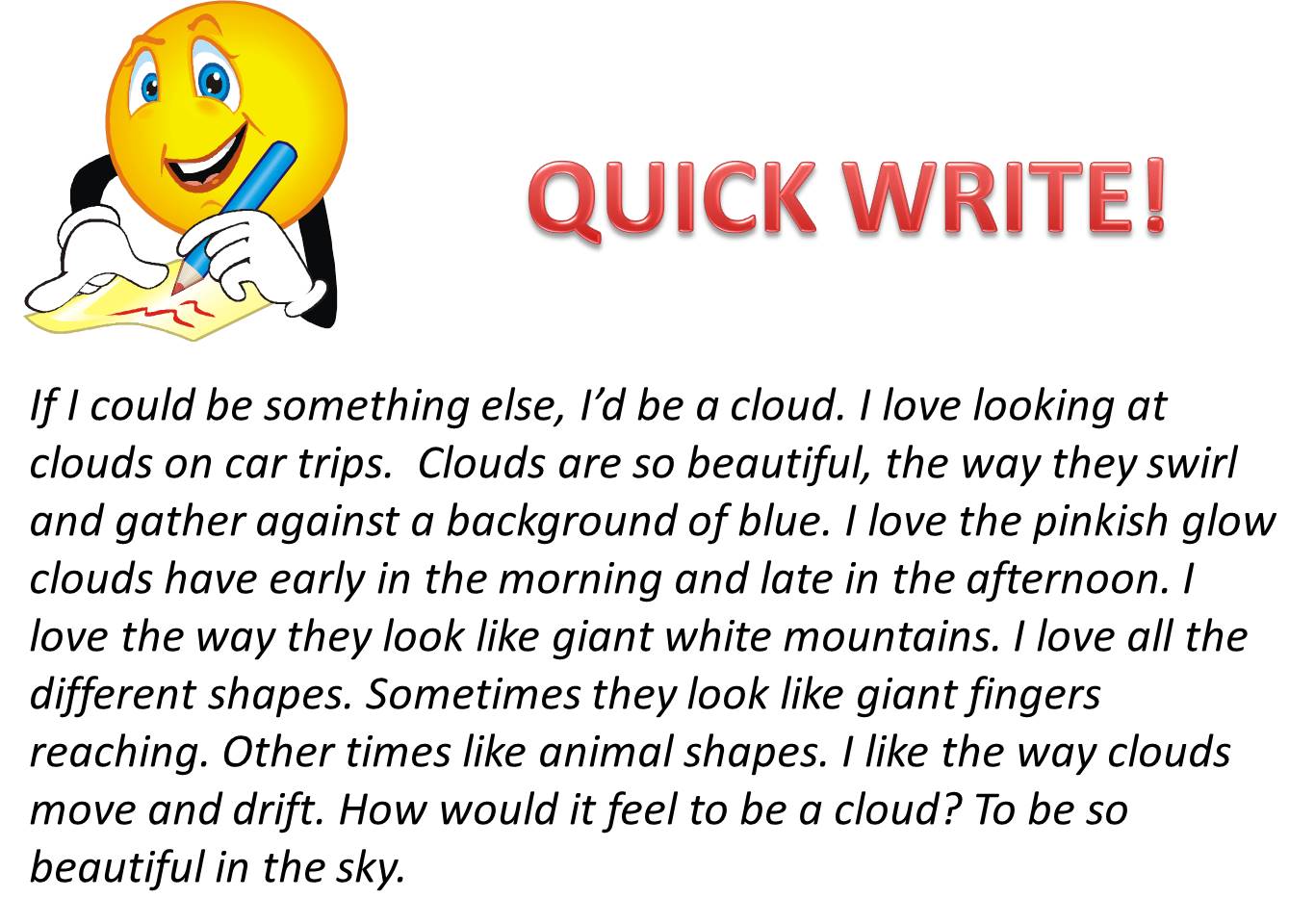
Writers of all ages are inspired by the simple suggestion to imagine themselves as a different entity. Model the process by using your own poem or my poem, “If I Were A Cloud.” I chose this subject because watching clouds is not only a joy but a consolation for me. Their floating beauty in the sky often lifts my spirits. To begin the exercise, ask your students to do a quick write on their chosen topic. Here is my quick write:


Then form a list of words that could be used in the poem to describe your feelings:


Finally, create the poem, using the line “If I were . . .” at the beginning of each stanza. Note that the poem does not have to rhyme. Encourage your students to choose figurative language over a forced rhyme scheme. It is more important to paint a picture for your reader than to rhyme. Here is an image of my poem, “If I Were a Cloud.”


In addition, or before you have students write individual poems, you might do a group writing exercise with the same process. Quick Write, Quick List of Words, Poem.

Have fun imagining!


Monday, August 22, 2016

Write your own WOW story

Guest Post by Mary Amato

In my latest book, Our Teacher is a Vampire and Other (Not) True Stories, the kids in Mrs. Penrose’s classroom get advice from their favorite author about how to write a great story. The author teaches them a simple process that she calls writing a WOW story. 


I developed the idea of the WOW story after reading Aristotle in graduate school. WOW is my easy way of remembering what the wise philosopher had to say about what makes stories work. WOW stories have three parts: a main character who wants something, an obstacle that gets in the way, and a win by the main character at the end. Here’s an example.

Want: A cat wants a saucer of milk.
Obstacle: A dog gets in the way.
Win: The cat sings the dog a lullabye; the dog falls asleep; and the cat wins by getting the milk.

Want to write a WOW story of your own? To write this story, think about what kind of personality traits your cat and dog might have. Is your cat shy or sassy? Is your dog grumpy or mean? Do your characters talk? What do their voices sound like? Think about where the story takes place. Inside a cozy house? In a scary, dark alley? Close your eyes and imagine the story like a little movie in your mind. Then open your eyes and try to write it.

You can also come up with your own ideas for WOW stories.

Make a Wow Book

In Our Teacher is a Vampire and Other (Not) True Stories, students write WOW stories and make them into books over their spring break. You can make a book, too. You will need sheets of blank paper of any size and a stapler.

Fold a few pages of paper in half so that it looks like a book and staple it twice on the outside along the fold line. (If your paper is wider than 3 inches, you’ll need a long-arm stapler to reach the fold line.)


To make your WOW book have a special look and feel, use one sheet of thicker, colored paper on top for the cover. After you fold it, put black masking tape on the fold to make a decorative reinforcement. Then you can staple it on the outside of your book along the fold line.


 Write your title on the front and your WOW story inside.


BIO: Mary Amato is an award-winning children’s and YA book author, poet, playwright, and songwriter. Her books have been translated into foreign languages, optioned for television, produced onstage, and have won the children’s choice awards in Ohio, Minnesota, Utah, and Arizona. She teaches popular workshops on writing and the creative process around the country. Visit her online at www.maryamato.com

Monday, April 21, 2014

Inhabiting Your Character or Historic Subject


How might we bring a greater awareness of our characters or historic subjects (George Washington, Harriet Tubman) to the page?

This is one of my favorite exercises as a writer—and one my students of all ages seem to relish and learn from. It’s playful and illuminating.

*Be your character or historic subject for a day (or at least a few consecutive hours).   Try to bring all your senses to it.

*Put on the clothes (or at least some) she would wear.  Eat the breakfast she would.  Do chores of the time (wash dishes, for example, or find a stable and pat the horses).  Play a game or read a book in the way your character would.

*Move like your character.  Let yourself inhabit that excited child or hungry dog or frightened slave. Skip down the street or sniff your dinner deeply or hide in a shed at night and peek out.  Walk as your character walks.  (For my picture book Underground Train, I rode the Metro in Washington, DC numerous times while inhabiting my child narrator, trying to experience the sounds and sights as she would.)

*Enact certain scenes, especially if they have intense action or emotion (within reason, of course).  For example, for an escape scene, have someone truss you up and feel yourself first bound and then trying to figure out how to escape.

*What does your character really like to do?  Do that!  What does your character hate to do?  Try that too, always being your character.

*Take on the physical proportions and usual posture of your character.  If your character is short, get down on your knees and see/experience as she would.  If your historic figure is tall, stand on a chair.  Is a character aggressive?  Puff out the chest.  Sad?  Let yourself slump.

*Jot down your reactions, thoughts, feelings, etc.  Weave into the writing or be conscious of as you revise.

*This can be done at any time during the writing process (prewriting, drafting, revising) to deepen a sense of character/historic subject and their world, provide more telling details, and heighten kinesthetic awareness.


Monday, March 26, 2012

Author and Illustrator for the Day, Part Two


In a previous blog post (January 2, 2012), I wrote about an upcoming “artist in residence” program I would be participating in at an elementary school. I'm happy to say I’ve just completed that residency with approximately 120 fourth graders.  It was wonderful getting a chance to know so many students by name, and by all accounts they really enjoyed creating their own books.  Prior to my arrival, I outlined a program and submitted it to the fourth grade teachers so they had a clear idea of what we would be doing.  The days broke down as follows:

Day 1: Introduction to the Art of Picture Book Illustration

What does an illustrator do?
How does an illustrator work?
How are illustrations for a book created?
How does the illustrator work with an author…or do they?

*manuscript acquisition
*thumbnail sketches
*final sketches and dummy book
*final art
*description of the printing and binding process
*printed book
*Q&A

Hands on:
-Explanation of the project student groups will create in the four days of workshops.
-Groups formed and “story prompt” cards will be created by students.
-Story cards mixed and randomly redistributed to groups.
-Students begin to brainstorm story ideas.

Day 2: The Writing Process

What makes a good story?
What elements should be included in a story?

*Memorable characters
*Beginning, middle, end
*Story Arc
*“Show,” don’t “tell”
*Pacing and page turns
*Writing to allow for interesting illustrations
*Satisfying endings
*Revisions

Hands on:
-Groups work on stories based on the story prompt cards they received.
-Text divided to fit on eight pages

Day 3: The Illustration Process

*different styles used in illustration
*different mediums used in illustration
*different color palates used in illustration
*giving the reader more than just depicting the written word

Hands on:
-distribution of thumbnail sketch sheets
-distribution of blank books (created using heavy weight construction paper folded and stapled )
-final sketches worked on if time permits or will be worked on at home that night. (Each student will be illustrating their own version of another group’s story).

Day 4: Presentation of Eight Page Books

Hands on:
*Students will be given a little time to complete illustrations for their stories and ask questions.
*One student from each group will read the story to the class and other students will present the art they created for the story.

Some questions to ask:

Are the illustrations successful for this manuscript?
Do they add something new and exciting to the story?
Do the characters come to life in the illustrations?
Do we get a good sense of place and time when looking at the illustrations?
Is the author (group) happy with the way their story has been illustrated? Is there a way the story could be edited to allow for more exciting illustration opportunities?
Was it fun to illustrate another group’s story?

For the most part we stuck to this schedule, but after the first day the teachers and I made one change.  The students were so excited about the stories they were working on and were already doing sketches of characters. I was told it was all they talked about for the rest of the day! Since they were already so invested in their work, we decided to forgo the idea of reassigning the stories to different groups to illustrate. I think this idea would work better if this was explained at the beginning of the project, or if the exercise was used in an older age group.

Next week all 120 books will be on display at the school so the entire student body can view the finished books. I was so proud of the work the children did, and so were they. If you think a book featuring a Nike sneaker, the zoo, and getting lost would be difficult to write, you just have to read Detective Nike and the Missing Panda!

Monday, October 17, 2011

WHAT IF? and WHAT ELSE?: Helping Young Writers Expand Their Stories

by Jacqueline Jules

What if your character was pursued by a wolf? How could she save herself?

What else could you add to make the reader feel your main character’s fear?

“What if?” and “What else?” These two short questions can help young writers get into the habit of expanding and resolving their fiction stories. Post them with a cute graphic and remind your budding writers to brainstorm throughout the creation of their stories, particularly when they find themselves stuck in the middle. Young writers are often unable to end their stories because their main character doesn’t have a problem to solve. Asking WHAT IF—the character wanted something, the character was afraid of something, the character was in danger, etc.—naturally leads to a problem in need of resolution.

The question WHAT ELSE? opens the conversation about adding details.

A great picture book for modeling this process is The Plot Chickens by Mary Jane and Herm Auch. In this book, Henrietta, a book-loving chicken, writes a story with the help of her three chicken aunts. Together, they brainstorm an adventure entitled, “The Perils of Maxine,” about a hen who ventures into the woods and is pursued by a wolf. Henrietta follows a set of “Writing Rules” which includes the very wise advice of developing your plot by asking the question, “What if?”

After reading The Plot Chickens with several groups of students, I’ve had a humorous frame of reference for asking the question “What if?” during writing conferences. Brainstorming should never be restricted to pre-writing. It is an essential part of plot and character development and the best way to move a stalled story forward. Questions fuel stories like gasoline powers cars. Help your students keep their pencils moving by asking “What if?” and “What else?”  

http://www.jacquelinejules.com/

Monday, September 5, 2011

Hiking Through the Writing Process

by Laura Krauss Melmed

The other day my husband and I climbed a mountain.  It wasn’t a Himalayan peak or even part of the Rockies, but a 1,000-foot forested slope of the Allegheny range.  The mountain, marked on a hiking brochure pulled from our “activities” file, is located not far from our vacation home in Western PA. Sure, the trail traversed a state hunting preserve, but we were (almost) sure August wasn’t hunting season, and the description of the hike promised lovely views along the crest of the mountain. 

After a short and scenic ride, we located the deserted and overgrown parking lot where we left our car, grabbed our backpack, and started in the direction of the orange markers blazed on the trees.  The brochure warned that we would soon come to an unmarked part of the trail; not to worry, though, because after traversing about three tenths of a mile of open forest, it would be easy to pick up the trail again.  Well, maybe for some, but for these urban adventurers, things were to take (literally) a different turn.  Not immediately picking up on the blazes again, we set forth fearlessly up the mountain.  Unfortunately, we were traversing a thorn forest.  Thorny creepers clutched at our legs.  Thorny trees repelled our grasp.  Undaunted, we persevered, slogging ever upward, but never actually finding the trail. 

At last, shards of sunlight penetrating the dusky foliage above us indicated that we might be nearing the top of the mountain.  Did I mention that all during this climb, we had been hearing intermittent gunshots in the distance?  At this point it seemed prudent for me to lean against a tree and consult my Smartphone to ascertain the dates of hunting season in Pennsylvania.  My husband insisted on climbing ahead to reconnoiter.  Returning to me at my resting spot, where I had determined that hunting season was not yet in force (we surmised that the gunshots were those of a neighboring farmer taking target practice), he reported that the top of the mountain was indeed close above us but that he could not locate the trail along the ridge. 

We decided to call it a hike and start down.  After another thorny adventure, only this time going downhill, we made landfall on a farmer’s private property (not the one who was taking target practice, we prayed) and had to climb over a cow fence.  My GPS then came in handy in locating the road along which we had parked our car.      

The moral of this story is, maybe those extra fees for my smart phone are actually worth it.  But beyond that, what does the story of this hike have to do with writing?  Actually, a lot.   Beginning a new story is the start of an adventure, much like undertaking a hike into unknown territory.  The trail may seem to be clearly marked, if you have mapped out the story in your head or written an outline, but once you begin the writing process, you often go off the trail.  This may be for the best, as it is the process of writing itself that points to sometimes thrilling new vistas and possibilities to which the writer must be open.  But sometimes while working on a manuscript, I feel that I have gotten lost in the woods.  Often a session of hard work may result in taking a path that leads nowhere, or to a place I don’t really want to be.  Then it is my job to try to find the path that will lead me to the top of the mountain—a finished poem or story that shines. 

If I don’t find that path, I may have to give up on this story for at least a while and start another.  But it is important to keep sight of the fact that in the process itself, there are always lessons to be learned and skills to be gained.  In climbing the mountain, my husband and I still had the chance to take a brisk climb together on a beautiful day in the woods.  We had the feeling of accomplishment that comes with knowing that we ascended 1,000 feet.  We had a shared adventure, and the most delicious peanut butter and jelly sandwiches and fresh peaches waiting for us to devour at our post-hike tailgate picnic.  Plus, this adventure gave me a subject for this blog! 

In the same way, when considering your own work or your students, remember that losing one’s way is not always the worst thing that can happen.  It can open new vistas, offer new lessons, and may even lead, eventually, to the top of the mountain! 

http://laurakraussmelmed.com/


P.S. Don't forget to comment and enter September's giveaway!

PENCIL TIPS GIVEAWAY!
Win a signed copy of I'm Not by Pam Smallcomb
To enter, leave a comment on a Pencil Tips blog post
Random winner contacted September 30th

"...a fresh take on friendship/reassurance stories and is, for sure, not boring"
- starred review Kirkus Reviews December 2010

Leave a comment at any Pencil Tips blog post between now and September 30th
for a chance to win a signed copy.

Monday, June 20, 2011

Costumes,Crafts, and Creative Writing Fun!


Nothing says fun to kids like a party.  Yeah, all we teacher-librarian-writer folks know that writing is good for students (like academic broccoli), but we also know that a playful touch can help create a truly memorable experience.  Occasional cupcakes, costumes, and crafts can perk up classroom writing and reading.  And your “book party” may well become the highlight of the school year.

Fellow blogger/author Pam Smallcomb gets the sparkly crown for her edu-taining ways.  At events for her most recent picture book, Earth to Clunk, about space buddies, Pam has the kids make their own aliens.  Her go-to spot for inexpensive craft items and doodads?  Oriental Trading Company http://www.orientaltrading.com/.

Dressing up and doing a dramatic reading can help bring a book to life for students—and provide insights on creating dialogue and story tension.  Okay, I admit it:  I love dressing up as a book buccaneer for my picture book Pirate vs. Pirate.  And at Maret School recently, librarian Lisa Triggs asked the children to dress as pirates—and did so herself.  She decorated the library with homemade Jolly Roger flags and enticingly displayed other pirate books.  Arrrr, we had a fine time, mateys, acting out the story, learning about the writing process (with a piratical plume pen), and writing a pirate poem.

And, oh, kids love a setting that mirrors a book!  Librarian Jess Stork transformed Palisades Library into a pirate hang-out with treasure map and chest, gaudy bling, and wanted posters of the author.  Refreshments added a celebratory note.  (Ginger) ale flowed freely, and the Jolly Roger cupcakes were a welcome change from hardtack.  “Captain Jess” sported pirate duds and helped the excited attendees to make their own spy glasses with the paper-towel rolls, markers, stickers, sequins, feathers, and glue arranged like jewels on the table.

Both Lisa and Jess bring a certain “magic” to their book interactions with kids.  The key to the good times—and the learning--lies with them.  Lisa and Jess get excited about writing—and communicate that by word and example to the youngsters.  A big pirate huzzah to them—and to like-spirited teacher-librarian-writers!

Jess shares piratical decorating tips, activities, and photos at
My website www.maryquattlebaum.com has pirate writing exercises.


Monday, May 2, 2011

Stop To Cross The Street: Tips For Young Writers

by Jacqueline Jules

               As a teacher who regularly conferences with students during writing workshop, I find myself asking many of the same questions repeatedly:  
            Are you sure you want two lines of exclamation marks? Let’s count how many times you’ve used the word “then.” Do you think you could cut a few of them out?
            Having the same discussion over and over again has prompted me to make a list of tips for young writers, modeled after the esteemed Jane Yolen. Last winter, at the New York conference of the Society of Children’s Book Writers and Illustrators, I heard her engage an audience of over a thousand with a clever list of guidelines. She began with “Eschew the exclamation point” and “Go easy on adverbs,” ending with a charge to all in attendance to go home and WRITE. In this spirit, I offer my own list for my students and young writers everywhere. 

  • Tip Number One: Use Your Inside Voice. Limit your use of exclamation points and capitals. Ten exclamation points in a row and capital letters are like shouting at your reader.

  • Tip Number Two: Stop To Cross The Street. Watch out for the conjunction “and.” More than three “ands” in the same sentence can be a signal to stop and use a period. 

  • Tip Number Three: Dare to be Different. Beginning every sentence with “then” or “the” can be dull for the reader. Rearrange your words to vary the sentence structure.
   
  • Tip Number Four: Play With Words, Not Fonts. Spend your writing time choosing the perfect descriptive word, not the prettiest font type or size.

  • Tip Number Five: Be Active. Use action words to describe what happened and avoid using “was” unless it is necessary to your meaning. For example, say Rapunzel “walked” across the street instead of Rapunzel “was walking” across the street. Repeated use of the word “was” weakens the action. 

  • Tip Number Six: Break it Up. Divide your stories into paragraphs. Indent or skip a line at the beginning of each new topic. It can also be easier for a reader to follow dialogue when you begin a new paragraph for each speaker. 

  • Tip Number Seven: Switch Places. Check to make sure your sentences are in the best order. Switching sentences or words around can make writing flow in a more logical manner.

  • Tip Number Eight: Remember the Reader. Too many parenthetical asides and distracting details can confuse your reader. Make things as clear for your reader as possible.

  • Tip Number Nine: Be Smooth. Use transitions such as “After we went to the mall, we went home,” rather than Chapter 1, Chapter 2, Chapter 3 to indicate a change of time or scene. Chapters divisions are for novels, not short stories.  

  • Tip Number Ten: Make a Pretty Picture. Your job as a writer is to make a picture in your reader’s mind. Make sure you have included enough color and detail for your reader to see the same story you see in your mind.
        
Jacqueline Jules

Monday, February 7, 2011

PENCIL TIPS WRITING WORKSHOP: SALT IN THE SOUP OR HOW I LEARNED TO WRITE

by Jacqueline Jules

The more I work with student writers, the more I think about how I developed my own writing skills. When did I become careful about punctuation and spelling? When did I start making a conscious effort to add sensory details or to build a story arc with a satisfying conclusion? Looking back, I see that I learned to write the same way I learned to cook—by testing recipes and listening to advice.

As a young bride, I remember my mother-in-law tasting my soup and pronouncing it too salty to eat. You can bet that I followed the recipe more carefully the next time. I also remember a professor, my first year of college, who wrote in red ink, “Don’t bother passing in a paper with this many typos again.” My embarrassment over both incidents has changed to gratitude. Now I measure how much salt I put into my soup and I proofread my manuscripts carefully. Editors at publishing houses frequently admit that stories submitted with grammatical errors are tossed without reading. If I had never listened to that professor, I wouldn’t be the author of twenty-two children’s books today.

The first book in my Zapato Power series, Zapato Power: Freddie Ramos Takes Off, is dedicated to my writing group. Dedications like this are not uncommon. Authors frequently pay homage to the critique groups who made the suggestions that transformed a mediocre story into a publishable one. Editors are often thanked as well. Every time I read my Thanksgiving picture book, Duck for Turkey Day, I am grateful to my creative Albert Whitman editor, who gently but firmly guided me into writing an important new scene for the book.
      
Contemporary writing curriculums all urge educators to teach the writer, not the writing. While I understand that this advice is to discourage teachers from overwhelming young writers with too many suggestions at once, I still find the distinction puzzling. In my own experience as a writer, I know I have learned a great deal from the revision process of a particular piece, often guided by others who pointed out places in my story that didn’t make sense or fell flat. And I have seen my students come up with absolutely brilliant ideas for revision when I have questioned a sentence that confused me. I trust that my students will find that the lessons learned from fixing one story will carry over to the next. It is the recipe that guided me and most of the authors I know to publication.

Jacqueline Jules