Showing posts with label Imagination. Show all posts

Monday, July 23, 2018

Birthdays, Chickens, and Writing Fun!


I Got A Chicken For My Birthday, written by Laura Gehl and illustrated by Sarah Horne, is about a little girl who wants tickets to the amusement park…but receives a chicken instead.


After you read I Got A Chicken For My Birthday to your students, you can use the story as a writing prompt in the classroom. Here are some suggestions to get kids writing:

1) In this book, the chicken builds Ana an amusement park in her back yard. If you received a magical engineering chicken for your birthday, what would you want your chicken to build for you? Describe the creation you would wish for.

2) Ana has a special relationship with her grandmother, Abuela Lola. Think of a member of your family, or a neighbor or family friend, who is special to you. Write about that person and why you feel close to him or her.

3) At first, Ana is disappointed that she received a chicken instead of tickets to the amusement park. Have you ever received a gift that you weren’t expecting or didn’t want? What was it? What did you want instead?

4) The chicken gives Ana a list of items needed for building the amusement park. The list has both practical items and silly items. Make up your own list of supplies for building an amusement park. What would you include on your list?


Monday, June 25, 2018

Pillows, Dogs, and Writing Fun


My Pillow Keeps Moving, written by Laura Gehl and illustrated by Christopher Weyant, is the story of a lonely man who tries to buy a pillow and accidentally buys a dog—who becomes his new best friend.


After you read My Pillow Keeps Moving out loud to your students, you can use the story as a fun writing prompt. Try these suggestions for getting your students writing:

1) In this story, a man walks into a pillow store and accidentally buys a dog. Write your own story using this formula:
? walks into a store to buy ? and accidentally buys ?
Replace the first question mark with a character, the second question mark with an item you might buy in a store, and the third question mark with an animal.

2) The man in the story starts out with no pets and ends up with two. Do you have a pet? Do you wish you had a pet? What pet would you like to have, and why? You can even write about an imaginary creature you would love to have as a pet, like a unicorn or a dragon!

3) This book has a lot of pages without text, where the story is told only through pictures. Choose one of those pages and imagine that you need to describe what is happening to someone who cannot see the illustration. Use words to tell that part of the story.


Monday, May 21, 2018

Experimenting with Imagination


guest post by Sue Fliess

The title of my new book Mary Had A Little Lab came to me in a dream—really. So when I visit schools and talk about this book, I tell them that they can dream up any story they want—or any machine they’d like—the only limit is their imagination. 

 My book is about Mary, a scientist and inventor, who makes her own dreams come true. She doesn’t have friends, so she decides she needs a pet. But rather than buy one, she makes one! A sheep, of course.  Once she makes a sheep, she is no longer lonely, and it soon allows her to make friends. Then her friends want sheep as well. But her Sheepinator goes haywire and starts making so many sheep that she and her new friends have to solve this new problem. The story has several problems that Mary and her friends must solve before the end. It’s like any experiment—things don’t always go right the first time. It takes many tries. Just as this book did to get it right!

One fun activity I do with students when I visit schools is to have them line up and recreate the Sheepinator from my book. They each have to choose what function they serve, what simple machine or movement their body must do to perform that function, and what sound it makes. They go in order, until, at last, a sheep pops out in the end—one student getting to be the sheep (I have a costume for this part, but that’s not necessary!). This gets them thinking about machine parts, how things work, and how things must work together.

Another activity is to have students create their own version of a Sheepinator. Draw a schematic on paper, then build it with arts and crafts and explain how it works.

A third, and maybe my favorite, it to ask students “If you could construct a machine to make anything you wanted, what would it be and what would it make?”  This allows them total freedom. Maybe they want to create an ice-cream-o-scooper, which makes any flavor of ice cream with the push of a button. Or a Cash-o-matic that spits out money. They can draw it, explain how it works, and even create a 3-D model of it, if they like.

Let the inventions begin! 

Sue Fliess ("fleece") is the author of numerous children's books including A Fairy Friend, Calling All Cars, Robots, Robots Everywhere!, The Hug Book, Tons of Trucks and Shoes for Me!  Sue lives with her family and a Labrador named Charlie in Northern Virginia. For more information about Sue and to check out her books and song parodies, go to http://www.suefliess.com/

Monday, December 11, 2017

It’s a Parody Party!

guest post by Sue Fliess

Okay, so maybe I get overly giddy about writing parodies, but for me they are just so much fun! I’m not sure what inspired me to write my first parody song, but once I did, I was hooked. Essentially, I like to take popular songs and change up the lyrics to make it about writing or poke fun at part of the writing journey. I think it’s cathartic to me to be able to express some of the less appealing parts of being in book publishing or being a writer. Humor gets me through the rough patches, and I figured others in the same boat might need a laugh. I’ve done parodies on finishing a book, revising, wanting more books, and even dipped my toe into the political spectrum. But I had not thought of doing a parody for a book, which seems hard to believe! So when an editor, who’d seen my parodies, asked me to try my hand at a parody for a children’s book, I said yes! And We Wish For A Monster Christmas was born!


Try it with your class!
Depending on the age of your students, you can have them do simple or more complex parodies. For the younger set, maybe just take the title of songs they know, and have them change the titles, or just the main chorus. For older groups they can choose a song and rewrite all the lyrics. What I do is print out a page with 2 columns. The left column I have the actual song lyrics and on the right, I create my own to match the beats or syllables. But since it’s a parody, it doesn’t have to be exact. Also, my parodies surround a central theme, but for younger students, it may be a challenge to rewrite a whole song around one topic.

Literary parody
Not in the mood for music? Have your class write a parody of a nursery rhyme or poem they know from a collection. For instance, Mary Had a Little Lamb or Humpty Dumpty might be good starters. Again, they can just create a new title, or rework the whole piece.

No matter which direction you choose, it’s sure to be a fun activity that lets kids be silly and use their imaginations. 

Sue Fliess ("fleece") is the author of numerous children's books including A Fairy Friend, Calling All Cars, Robots, Robots Everywhere!, The Hug Book, Tons of Trucks and Shoes for Me!  Sue lives with her family and a Labrador named Charlie in Northern Virginia. For more information about Sue and to check out her books and song parodies, go to http://www.suefliess.com/


Monday, May 15, 2017

GETTING LOST WITH BOB AND JOSS

Guest Post by Peter McCleery

Getting lost is one of those universal experiences that everyone can relate to. We all have a “getting lost” story. School visits for Bob and Joss Get Lost, my debut book, have led to some very enthusiastic discussions about this topic with students. Not only are they eager to share their stories about getting lost but they LOVE to brainstorm ideas about where Bob and Joss should get lost on their next adventure.


One of my favorite classroom writing activities is to get students brainstorming. For some students (and authors) deciding on what to write about can be very challenging. It’s a skill that often gets overlooked in writing assignments. It’s important that children have the space, time and freedom to answer the all-important “what if” question when coming up with ideas. And with Bob and Joss as a prompt, students can have a lot of fun getting lost in their ideas.

As a brainstorming writing exercise ask students to come up with a list of at least ten different ways or places that Bob and Joss can get lost on their next adventure. The more the better. Make it clear that there aren’t any limits to what they can imagine for these characters. I’ve had students suggest things from “in school” or “at the mall” to “in space,” and “in their brains.” (whatever that means!) It’s important to let them know that there are no wrong answers when brainstorming!

Have the students share some of their favorite ideas and list them on the board. Giggles are guaranteed! You could also use Bob and Joss as a starting point for a discussion about getting lost. Have students share real-life stories about a time when they got lost. Perhaps on a hike, or in a store, etc… Discuss what it felt like. Was it scary? Was it exciting? How did you feel when you got home? Relieved? Disappointed? This can also lead to a discussion about safety and what to do if they get lost.

Another aspect of Bob and Joss that proves useful in the classroom is an introduction to the geographic coordinates of latitude and longitude. Sharp eyed readers will notice that on each spread of the book there is the current location of the characters in coordinates. In fact, you can track their journey by putting the numbers into a digital map, like Google Maps. No spoilers here, but the numbers are real places on the earth! It’s a fun way to discuss mapping, coordinates and geography. You can even figure out exactly where your classroom is and write those coordinates on the board!

BIO: Peter McCleery is the author of the hilarious Bob and Joss series of children's books, Bob and Joss Get Lost! (February 2017) and Bob and Joss Take a Hike! (coming in 2018). He lives with his wife and two children in Portland, Oregon where he occasionally gets lost. His favorite things include kids (and adults) who laugh. He’s also written for Highlights magazine and for grown-ups on the McSweeney’s humor website. 

You can find him at www.petermccleery.com, on Twitter: @pmccleery and on Facebook: @petermccleeryauthor


Monday, February 20, 2017

Fantastic Flowers as Mentor Text

Guest Post by Author/Illustrator Susan Stockdale

Let’s explore flowers that look like other things!

Fantastic Flowers celebrates 17 flowers from around the world that resemble objects, creatures and even people, from spiraling spoons to flying birds to sleeping babies. The rhythmic, rhyming text and bright, bold illustrations bring to life this dazzling display of surprising blooms. Fantastic Flowers encourages object identification and inspires children to observe nature more closely. Back matter provides information on the pollination process, color photos of the flowers (so children understand that they are real!) and a flower identification guide.


Before reading, show students the flower illustrations in the book. Ask them what they think the flowers resemble.

Writing prompts

• Write a paragraph about your favorite flower in the book, stating the reason you chose it.

• Select a flower in the book and generate two lists: one with adjectives (e.g. wild baboons) and one with verbs (e.g. skittering spiders) that describe it. Write a paragraph about the flower using your adjectives and verbs.

• Select a flower in the book and write a few sentences about it that integrates the information provided in the back matter, which includes the flowers’ common names, scientific names, native range (habitat) and pollinators.

• Create your own name for each flower, being as imaginative and playful as possible.

• Select two flowers in the book and imagine that they can speak. Write a few sentences imagining what they might “say” to one another in a conversation. For example, how might they compliment one another?


BIO: Susan Stockdale freelanced as a textile designer for the apparel industry before becoming the author and illustrator of 8 picture books for young children. Her books celebrate nature with exuberance and charm and have won awards from the American Library Association, Parents’ Choice, the National Science Teachers Association and Bank Street College of Education, among others. She lives with her husband in Chevy Chase, Maryland. Visit her website at www.susanstockdale.com. 

Monday, February 13, 2017

"If I" Poem


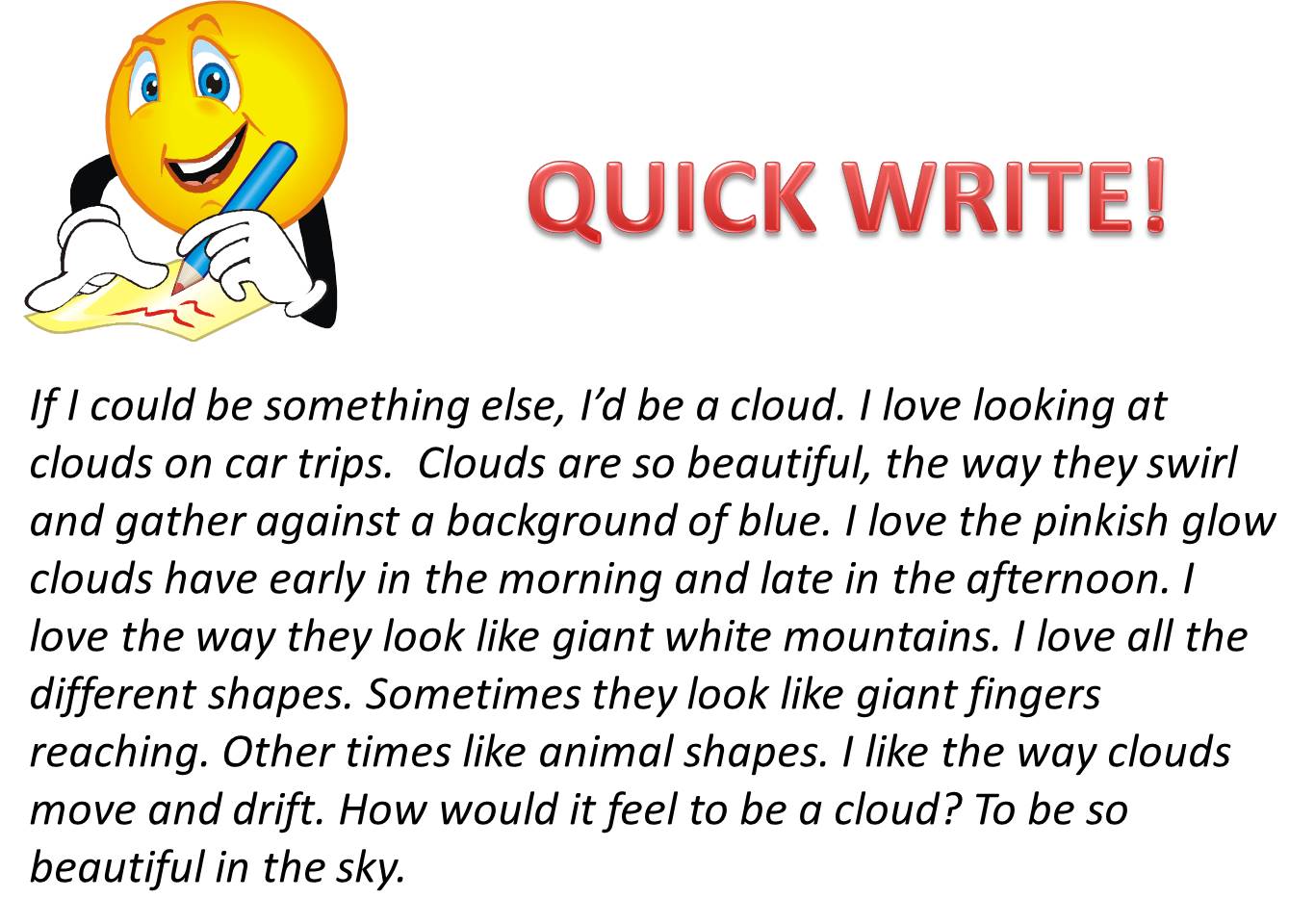
Writers of all ages are inspired by the simple suggestion to imagine themselves as a different entity. Model the process by using your own poem or my poem, “If I Were A Cloud.” I chose this subject because watching clouds is not only a joy but a consolation for me. Their floating beauty in the sky often lifts my spirits. To begin the exercise, ask your students to do a quick write on their chosen topic. Here is my quick write:


Then form a list of words that could be used in the poem to describe your feelings:


Finally, create the poem, using the line “If I were . . .” at the beginning of each stanza. Note that the poem does not have to rhyme. Encourage your students to choose figurative language over a forced rhyme scheme. It is more important to paint a picture for your reader than to rhyme. Here is an image of my poem, “If I Were a Cloud.”


In addition, or before you have students write individual poems, you might do a group writing exercise with the same process. Quick Write, Quick List of Words, Poem.

Have fun imagining!


Monday, November 28, 2016

IF YOU COULD HAVE A SUPERPOWER


I am excited to announce that Freddie Ramos Rules New York was released in October 2016. This book is the sixth in the Zapato Power series about Freddie Ramos, the boy with super-powered purple sneakers. 


In Freddie’s newest adventure, he outgrows his special sneakers and must adjust to a larger pair. But will his new shoes work as well as his old ones? Freddie  contemplates the possibilities during a bus ride to New York.

          Uh-oh! Did my new zapatos give me super hearing? What about super speed? And super bounce? Could they do all three? I had two buttons on my wristband. What if two powers was all I got? Which ones did I want the most?
          Super hearing would be good when I wanted to hear what grown-ups were saying. Would I like it as much as running fast?
          I had to get off the bus and find out what my new shoes could do! But I was stuck in the window seat, watching more brown fields and buildings go by. How much longer till New York?

The inspiration for the Zapato Power series came from students when I worked as an elementary school librarian. My students never tired of discussing their favorite superpower and the requests for books on superheroes never stopped. The interest was especially intense when I shared Margaret Mahy’s The Seven Chinese Brothers in story time. This traditional tale is about seven identical brothers who each have a special skill. One brother has super strength. Another brother has super sight and so forth. My students and I had many lively conversations over which brother had the best super skill.
         
The process of choosing one superpower over another can develop critical thinking skills. Ask your students to write pros and cons for a list of selected superpowers. This can lead to a persuasive writing exercise in which students explain why the superpower of their choice is the most useful and effective for their particular needs. A high interest topic like this can motivate even the most reluctant of writers.
         
In the Zapato Power books, Freddie Ramos has trouble navigating the ordinary world with his superpowers. Ask your students to write about how they think their lives might change if they had super speed or super hearing. What kind of challenges might they face? Would it be difficult to keep your superpower a secret? Would you be tempted to eavesdrop on your friends or use super speed to an unfair advantage in athletic events? Ask your students to really examine how they would use their superpower and when.

There are many questions to consider. Would you try to stop bullies and make the world a better place? Would you enjoy doing good deeds if no one knew you were responsible? A list of writing prompts are available on this page of the Zapato Power Activity Guide. Enjoy!


Monday, July 25, 2016

May The Force Be With Your Creative Writers

Guest Post by Laura Krauss Melmed

I wrote my latest picture book, Before We Met, while channeling the remembered wonder and anticipation of awaiting the birth of a child.  In the book, an expectant mother imagines the baby’s smile, the feeling of its skin, the sound of its cry.

In Before We Met, sumptuously illustrated by Jing Jing Song, an expectant mother tells of her hopes and dreams while waiting for her child to be born. 
Just as adult life often entails waiting, children too must wait for all kinds of exciting events, such as a birthday party, a vacation trip, the first day of school, that first loose tooth, or getting a pet.  Using Before We Met as a prompt, children can learn that writing about an anticipated event and its imagined outcome can be a fun way to deal with having to wait.

Here’s the set-up:  Your students are enrolled in the Intergalactic Home Visit Program. In one month, a Star Visitor from a distant planet will be coming to spend a week with them at home.  Because of Intergalactic security rules, your students won’t know any details about the Star Visitors or their home planets until right before they arrive. 

Ask students to draw a picture of their imagined visitor and the visitor’s home planet. Then ask students to write answers to these questions.  

How are you feeling while waiting for your Star Visitor to arrive?
How will you and your Star Visitor greet each other? 
Where will your Star Visitor sleep? 
How will you make your Star Visitor feel at home?
How will your pets react to the Star Visitor?
What does your Star Visitor like to eat?  What Earth foods would you like to introduce them to? 
What games might your Star Visitor teach you?   What games will you teach them? 
What special powers might your Star Visitor have?
What parts of your neighborhood will you take them to, and how might other Earthlings react to meeting them? 
What will it be like when your class brings their Star Visitors to school?
What gift will your Star Visitor give you when they leave?
What will you give your Star Visitor to take back home?

A follow-up exercise could be for students to write about what the visit was “really” like compared to their expectations, and how they felt after their Star Visitor left. 

May the Force be with your student writers as they aim their imaginations toward the stars!

Laura Krauss Melmed is the author of twenty fiction and nonfiction picture books for children, including the New York Times bestsellers, The Rainbabies and I Love You as Much.  Her books have garnered many awards, including the ALA Notable Award, National Jewish Book Award, Notable Children's Trade Book in the Field of Social Studies, Parent's Choice Award, Oppenheim Gold Award, Maryland Black-Eyed Susan Master List, and the American Bookseller Pick of the Lists.  She holds an M.Ed. in early childhood education and has been a kindergarten teacher.  Laura loves connecting with students and teachers face-to-face through school visits and writing workshops. She tutors in the DC Schools with Reading Partners, a national organization committed to helping children find the magic key to literacy.  Visit Laura online at www.laurakraussmelmed.com

Monday, February 15, 2016

COME ON, FEEL THE NOISE!

guest post by Nancy Viau

Kids love sound words, and onomatopoeia is often taught as early as kindergarten. Students know that onomatopoeia makes reading aloud fun, but do they know that they can use onomatopoeia in their writing now and for many years to come? Why not help them create an Onomatopoeia Resource List?

Encourage students to listen for the sounds in and around their classroom—the tick, tock of clock, hands clapping, fingers snapping, water splashing, shoes clacking, birds tweeting, etc. Name the onomatopoeia and begin your list as a class (tick, tock, clap, snap, splash, clack, tweet). Students copy the words in their writing journals, leaving plenty of room for additions.


Introduce Storm Song, one of my titles. Prepare for reading by asking students what sounds they hear during a storm, then read it straight through. Talk about what happens in the story and ask if the story contains any onomatopoeia. Have kids add these words to their lists.

Next, do the same thing with City Street Beat, my latest rhyming picture book. Like Storm Song, it’s filled with onomatopoeia. As you read it aloud, you’ll find that students have acquired quite an ear for sound words.


At this point, Onomatopoeia Resource Lists should contain approximately 100 words! Here’s a cool fact: My personal ORL has 402 words—YAY! 

Extended Activities:
Come On, Write the Noise: Students imagine a noisy setting such as a city, pool, zoo, amusement park, airport, farm, pet store, or home. After brainstorming noises in pairs, they get those pencils TAPPING and use at least 10 sound words in a one-page story.

Come On, Spell the Noise: Add the word “onomatopoeia” to spelling tests. Getting 12 letters in perfect order is something to be proud of. WHOOT!

Come On, Find the Noise: Work with the school librarian and help kids ZIG and ZAG, SHUFFLE and ZOOM through the library to find titles that contain onomatopoeia. 

Here are some helpful lists:

https://www.librarything.com/tag/onomatopoeia

BOOM! Your students understand the importance of onomatopoeia and now have a resource list to use, and add to, for the next decade.

Nancy Viau is the author of three picture books: City Street Beat, Look What I Can Do! and Storm Song, and two middle-grade novels: Samantha Hansen Has Rocks in Her Head and Just One Thing! (Fall 2016). In her interactive, energetic story hours, assembly programs, and writing workshops, Viau gets young readers rhyming and writing on the spot. She’s a Jersey girl with ties to both the country and the seashore, and finds inspiration in nature, travel, and her job as a librarian assistant. www.NancyViau.com


Monday, November 30, 2015

IF YOU COULD FLY ON A GIANT BIRD


In my picture book, Princess and the Ziz, a princess flies all over the world on the back of a giant yellow bird.  The Princess and the Ziz is my own retelling of a very old Rapunzel tale involving King Solomon’s daughter who was rescued from a tower by a giant yellow bird called the Ziz.

During author visits, I often challenge young writers to imagine what it would be like to ride on the back of a giant bird. Where would you want to go? I’ve had many lively discussions with students about where they would like to go if they could ride in the air with a bird. While some students say the Bahamas, Disney World, or some other vacation spot, others tell me they’d like to visit grandparents or other relatives. One student told me she would like to fly over the rainbow with a giant bird. Now wouldn’t that make a good story!

Once a destination has been decided, students can brainstorm what they would see. If you are flying over Antartica, you might see penguins and snow. If you are flying over the jungle, you would see lots of greenery. Ask younger students to describe the scene in as much detail as possible. Older students could combine this writing exercise with geographic research. For example: If you were flying over Egypt, you would see pyramids. What else?

From there, students should consider what they would hear on their journey through the air. On the back of a bird, not enclosed the way you are in an airplane, you would hear the wind and the flapping of wings. Could you describe that? If you were flying over a city, you would hear the noise of traffic and building construction. What would that sound like? This could be an opportunity to encourage your students to use onomatopoeia. Students could make up their own words to imitate what they might hear from way up in the sky.

Finally, how would it feel to be in the sky on the back of a giant bird. Would you be frightened or excited? Would it be chilly? Would the ride be smooth or bumpy?

Visit my website for a writing template  to use in your primary classrooms.

The Princess and the Ziz is certainly not the only book which depicts a character flying in the sky via a giant bird. In Roald Dahl’s The Minpins, Little Billy flies around the world having adventures on the back of a giant swan. Fairy tales also depict characters riding on the backs of birds. Thumbelina in the story by Hans Christian Andersen flies on the back of a swallow.

Ask your students to write their own story about a character flying with the help of a friendly bird. Imaginations and feathers can soar through the clouds. Happy Flying!


Monday, August 24, 2015

SHOWING CHARACTER THROUGH ACTION


          One of the cardinal rules of writing is “Show, don’t tell.” This means that rather than telling readers that your character is bossy, you need to show her actually being bossy. Rather than telling readers that another character loves to daydream, you need to show her lost in reverie – and show us what the content of her fantasy is.


             In my new series, Franklin School Friends, my characters are defined by their interests and passions. Kelsey (Kelsey Green, Reading Queen) loves to read. Annika (Annika Riz: Math Whiz) loves math. Izzy (Izzy Barr, Running Star) loves to run. You get the idea! In each book, my challenge is to find a way for the girls to support one another (in trying to win a reading contest, a Sudoku contest, or a race) while using their own distinctive talent and abilities.


           So: as Izzy is trying to win a 10K race, Kelsey inspires her with the story of Atalanta’s famous race in Greek mythology and Annika helps her calculate how fast she needs to run each kilometer to beat her rival. When Kelsey suspects her rival, Simon, of cheating during a schoolwide reading contest, Annika figures out how many pages Simon would need to read in an hour to make good on his reading claims; Izzy spies on Simon with the plan of running fast if she gets caught.
       
   Here’s a way to share this characterization challenge with students.

1)    Let students pick a fun activity to be the focus of a scene. Examples might be: running a race, baking a cake, building a snow fort, starting a lemonade stand.

2)    Choose names for three characters to be part of the scene, preferably with a mix of boys and girls (and not using names of any kids in the class).

3)    Give each kid a character trait (e.g., shy, imaginative, clumsy, funny, determined, impatient, reckless, conceited, talkative). Or: give each kid a passion/talent (loves sports, science, math, music, reading).

4)    Then: how can we SHOW this in the scene? If our characters are baking a cake, what would the shy character be doing? The imaginative one? The clumsy one? The funny one? What would the sports-lover contribute to the baking? Maybe she’d volunteer to use her arm muscles doing the mixing or she’d be jogging in place as the cake bakes. What would the scientist kid contribute? Maybe wondering how differently the cake would turn out if they left out the flour or baking powder? What would the musical kid be doing? Maybe making up a cake-baking song for them all to sing?

The takeaway point for the students is: character is shown through ACTION. We know what kind of person someone is by seeing what he DOES. So: provide a fun activity, gather together a group of imaginary kids, and let them reveal themselves to us!

Claudia Mills is the author of over 50 books for young readers, including How Oliver Olson Changed the World (an ALA Notable Book of the Year) and The Trouble with Ants (which just received a starred review in Publishers Weekly), as well as the Franklin School Friends series of chapter books from Farrar, Straus & Giroux. Claudia lives in Boulder, Colorado, with her family and her cat, Snickers. Visit her at www.claudiamillsauthor.com.

Monday, July 6, 2015

HAROLD AND THE PURPLE CRAYON


Most of us are familiar with the classic children’s book Harold and the Purple Crayon by Crockett Johnson, first published in 1955. It’s a book I often checked out of the library as a child, and then later read to my own children. Now the book with its worn dust jacket sits upon a shelf in my art teaching studio. I have read the book many times to my young students, using it as an introduction to a lesson on line and shape.


In the story, using just one purple crayon, Harold draws himself a magical imaginary adventure. There are no limits, parents or rules for Harold to obey; his imagination and one purple crayon can take him anywhere.

Using the illustrations in the book, have students identify straight lines, zig-zag lines, curvy lines, wavy lines etc. Next, ask students to identify the basic geometric shapes that make up some of the drawings.

For an art and writing activity, make up individual blank books using any size white paper stapled or glued at the fold. Have each child draw themselves (using a purple crayon or marker) into their own imaginary story that begins and ends at their bedroom window. Ask older students to write text to accompany the illustrations, have younger students explain their drawings to the class.

Where will a purple crayon and their imagination take them?


Monday, February 2, 2015

MACHINE DREAMS

by Alison Ashley Formento

Machines are an important part of our lives and they are usually built using rocks and minerals, as I learned in researching my book These Rocks Count! We use computers, phones, and televisions on a daily basis. Doctors and dentists use machines to help keep us healthy. Cars, buses, planes, and trains are machines to help us get where we need to go each day. In winter, we rely on snowplows to help keep our roads and highways clean of snow and ice. Early snowplows were wooden and attached to horse drawn wagons to help push snow aside. In the early 1900’s, engineers wanted a way to help New Yorkers in the winter and designed a shovel type blade, strong and wide enough to clear city streets.

Most great inventions, like the snowplow began with an idea. Some ideas start as drawings scribbled on paper. Many inventions are the result of careful planning and experimentation, like the light bulb. A machine is usually useful, but it is often fun, too, like a giant roller coaster.

Machine Dreams: Writing Prompt

What machine do you wish existed? What if there was a machine to brush your teeth or make your bed? Or one to bring you ice cream just by thinking of your favorite flavor? Use your imagination to write about the machine of your dreams.

• What machine would help you in your daily life?

• Draw a sketch of the machine you imagine building.

• Name your machine.

• What exactly does your machine do?

• Write a description of your machine. Is it made of metal or plastic? Or some other material? Is it a particular color? Does it have many pieces to make it run?

• How does your machine operate? Does it have buttons, levers, or a keypad?

• Is your machine useful for everyone or only something you will use?

• How will your machine help you and others who use it?

www.alisonashleyformento.com

Monday, February 10, 2014

What Came Before? What Came After?


At a recent conference I attended, an artist representative spoke about consistency of character when illustrating a book, but also when showing work in your portfolio. She suggested including at least three sample illustrations in progression. Starting with one image, the advice was to do another two showing what happened with that character before that image, and what happened after. While good advice for illustrators, I thought this would also make a wonderful drawing and writing exercise to use in the classroom.

Using a picture book, pick out  a single illustration or a two page spread towards the middle of the book, using a book that children are not too familiar with. Cover any text with Post-it notes. 

Ask children to look at the illustrations, and then come up with their own drawings of what might have happened before this illustration, and what might have happened after. 

Depending on the age of the students, a more simple or complex book can be used for the prompt. This can also be used as a writing exercise only, or in combination with the drawings.

After children have completed the assignment, have them share work with their classmates, then reveal the illustrations and/or text from the actual book. How does the student work compare?


Monday, June 3, 2013

POST IT!: FIGHTING THE BLANK PAGE

by Mary Amato

Young reluctant writers are often turned off or afraid of the blank page. I made up an imagination game involving Post-it notes that gets kids excited. Give each child ten blank sticky notes. Tell your class that you are all going to create a new language by labeling ordinary things in the room with sticky notes. Each child has to choose ten objects in the room and invent new words for those things. Emphasize that you should be able to pronounce the new language. Let's use the clock as an example. In my new language I might label the clock, "hitzer." Kids will realize the importance of vowels!  Set a time limit for the labeling and when kids are done writing the labels let them put the labels on the objects. Take a group tour of the room, practicing how to say each new word. I created this game as a teacher after remembering the fun I had as a child trying to invent my own language. The new words gave rise to lots of stories about my newly invented culture. Have fun!

Monday, June 25, 2012

CREATE A WORLD

by Mary Amato

Fiction writers have the fun of creating an entire world. Teachers and parents can encourage kids to use cheap materials like shoeboxes and peeps to invent a 3D scene. As they are constructing the scene, ask them to be thinking of a storyline for the character (s) in the scene. 


Make a storybook to accompany the scene or simply allow for verbal storytelling. When I was a child, I told many stories as I played with my dollhouse. Creating a unique scene can facilitate even more interesting stories.

http://www.maryamato.com/

Monday, August 15, 2011

MORE STORY STARTERS

by Joan Waites

Back in November of last year, I wrote a blog entry featuring a “story starter” exercise which used a single prop to jump-start story ideas. At a recent workshop weekend offered by the Society of Children’s Book Writers and Illustrators ,workshop leader author David LaRochelle lead us in another “story starter” exercise that  would work well for students of all ages, and can be adapted to use as an “art starter” as well.

Using index cards, ask students to write down on five separate cards the following:

A Character 

 (Example:  spider, robot, 12 year old girl)

An Emotional Situation 

(Example:  losing your best friend, moving to a new country, not making the cut for the soccer team)

A Place

(Example:  frozen lake, another universe, the top floor of a skyscraper)

An Object

(Example:  sewing needle, lava rock, teddy bear)

Next, have students shuffle the cards and exchange 2-3 of the cards with a partner.

Finally, using the cards they have chosen, ask students to quickly write down ten ideas (one or two sentences) for a story based on the words on their cards. Pick one of these ideas and develop it further.

For a variation of this exercise, have students cut different pictures from magazines, newspapers, or junk mail. Ask them to find pictures of people, animals, places and objects and glue them to the cards.  Have students exchange several cards with each other.  Students will then draw a character in a location and/or with an object based on the cards they have chosen telling the story in their illustrations.

Using this exercise with either the written word or with pictures, students have endless possibilities to jump-start their imaginations!


http://www.joanwaites.com/

Monday, December 6, 2010

PENCIL TIPS: PROPS FOR IMAGINATIVE WRITING EXCERCISES

by Laura Krauss Melmed

Joan Waites blogged recently about using an egg to jumpstart inspiration in a writing class.  An inspired idea!

I, too, have found that props are a useful and engaging device for helping kids make the leap from “what is” to “what if.”  For example, at an urban elementary school where I tutor students in reading, I and a group my fellow tutors took our twelve tutees, ages six through ten, to a children’s theater production of The Dancing Princesses, a musical adaptation of the Grimm’s fairytale. 

In preparation for our trip, I shared with the children a beautifully illustrated picture book retelling of The Twelve Dancing Princesses by Rachel Isadora, set in Africa where Isadora once lived.  I asked the children to keep the book in mind when viewing the play and notice how they might be similar yet different.    

A post show group session provided a good opportunity for a writing exercise.  Seated in a circle, we reviewed the play (universally declared a hit) and talked about the differences and similarities between it and the storybook.  We agreed that one common important element was the princesses’ journey to a magic land.  Then I asked each student to imagine his or her own version of the magic land they would chose to visit if they could.  They were to describe it to the group and then write an illustrated page about it.  This is where the prop came in:  To spark the student’s imagination in a fun way, each one in turn got to put on a bejeweled and gilded cardboard crown that transformed the wearer into a princess or prince ready to begin a journey of the imagination. 

The children came up with magic places ranging from the seashore, to a huge playground, to a Transformer-land where a fearsome but “good” robot stood ready to fight the “bad guys.”  They eagerly illustrated their ideas, and with help from their tutors, wrote sentences explaining their pictures. 

To spur a writing exercise that spins off of traditional tales, props might be a pair of boots for Puss-in-Boots (where would they take you?),  a pumpkin for Cinderella (what besides a coach might it turn into?) or Aladdin’s magic lamp (what would you wish for?).   

In planning such an exercise, just go where your imagination takes you. 
http://www.laurakraussmelmed.com/